Managing a team in Brazil from the United States involves much more than sending money overseas. In addition to handling payments, businesses may need to deal with currency conversion, payment deadlines, invoices, contracts, accounting records, and different employment arrangements.
Therefore, choosing the right payroll software for Brazil can simplify part of this process. However, not every platform offers the same type of service. Some focus on HR and employment, while others specialize in accounting or international payments.
If you are already managing or planning to build a Brazilian team, understanding how payroll in Brazil works is an important first step.
With that in mind, below we compare five options U.S. businesses can consider when paying employees, contractors, freelancers, and service providers in Brazil.
What should payroll software for Brazil offer?
International payroll involves several processes that may not exist when a company only pays workers domestically. Therefore, before choosing a platform, businesses should evaluate exactly which activities they need to manage. Moreover, comparing platforms based only on price may not provide a complete picture, since each solution can cover a different part of the payroll process.
Currency conversion
If your company operates in USD while the recipient expects BRL, the payment process needs to account for exchange rates and currency conversion.
Ideally, an international payment platform should also make the exchange rate and applicable fees clear before the transaction. As a result, businesses can better understand the final cost while recipients know how much they should receive.
International payment processing
Traditional international transfers may involve intermediary banks and additional processing steps. On the other hand, platforms focused on cross-border payments can simplify this process by receiving the company’s payment in the United States and delivering funds locally to the recipient’s Brazilian bank account.
Consequently, companies may reduce some of the operational complexity associated with sending individual international transfers.
Taxes and transaction fees
International payments may involve transfer fees, exchange-rate spreads, and applicable taxes.
For that reason, businesses should compare the total cost of the transaction instead of looking exclusively at the platform’s subscription price. In addition, they should understand whether fees are charged to the sender, the recipient, or both.
Contracts and invoice management
The documentation required depends on the relationship between the U.S. company and the Brazilian recipient. For example, a company paying an independent contractor or service provider may need to maintain contracts, invoices, and payment records for accounting and compliance purposes.
Therefore, businesses should distinguish between paying an independent contractor and running formal employee payroll. After all, the legal and tax obligations are not necessarily the same.
Financial reports
Cross-border payments should also be properly documented for accounting purposes. For instance, reports containing beneficiaries, transaction amounts, exchange rates, fees, and payment dates can make reconciliation and financial management considerably easier.
Moreover, centralized financial records can help businesses understand how much they are actually spending on international operations.
Top 5 payroll software options for Brazil
There is no single type of payroll platform that covers every possible business model.
Instead, the five solutions below approach the problem differently. Therefore, the best fit depends on whether your company primarily needs payments, accounting, HR management, or a broader international workforce solution.
| Platform | Main focus | International payments | HR management | Contractor management |
|---|---|---|---|---|
| CambioPay | Payments to LATAM teams | Yes | Limited | Payment-focused |
| QuickBooks | Accounting | Requires additional solutions | Limited | Accounting-focused |
| BambooHR | HR management | Depends on payroll setup/integrations | Yes | Available through HR workflows/integrations |
| Deel | Global HR, EOR and payroll | Yes | Yes | Yes |
| Wise Business | International payments | Yes | No | No |
However, pricing, availability, and features can change over time. Therefore, businesses should always confirm current terms with each provider before making a decision.
1. CambioPay
CambioPay focuses on helping U.S. companies send payments directly to professionals, contractors, freelancers, and suppliers in Brazil and other Latin American markets. Instead of requiring each Brazilian recipient to receive an international wire and manage the conversion individually, CambioPay distributes the payment locally in Brazilian reais.
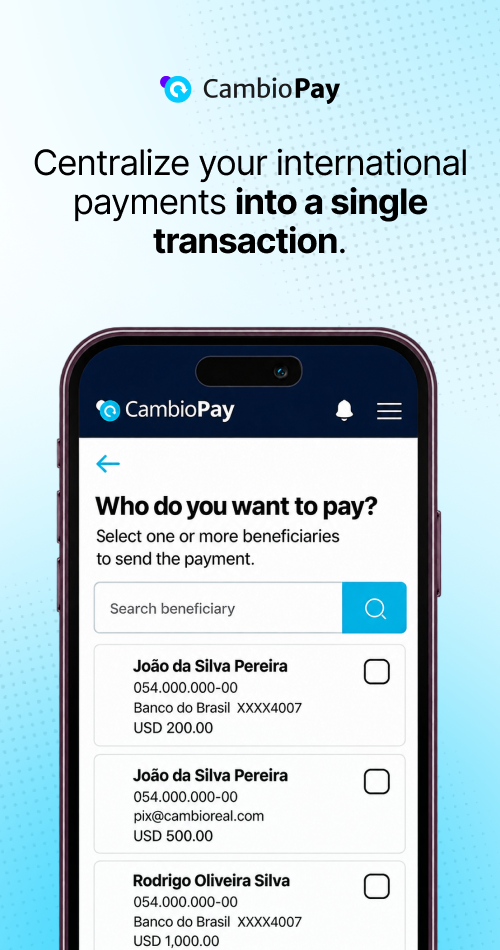
In addition, companies can add multiple recipients and make payments to their Brazilian team while managing the process from the United States.
Main CambioPay features
- Payments from the United States to Brazil;
- Recipients receive BRL directly in their Brazilian bank accounts;
- Payments to multiple beneficiaries;
- Spreadsheet upload for larger recipient lists;
- Exchange rate and payment amount presented before confirmation;
- English and Portuguese support;
- Reports for financial control;
- API solutions for businesses with specific integration needs;
- No monthly subscription;
- Transaction fees of up to US$3.99;
- FX spread below 1% according to current CambioPay information.
Therefore, CambioPay can be particularly useful when a company already works with professionals or service providers in Brazil and primarily needs a way to manage recurring cross-border payments.

However, it is important to distinguish the payment operation from a full HR or Employer of Record service. Companies remain responsible for choosing the appropriate hiring structure and meeting the legal and accounting requirements associated with it.
2. QuickBooks
QuickBooks is primarily an accounting platform rather than a Brazil-specific international payroll solution.
For example, businesses can use it to manage expenses, invoices, financial records, reports, and other accounting activities. As a result, the platform can be useful for companies that want payroll-related expenses integrated with their broader bookkeeping process.
However, a U.S. company that needs to send payments directly to Brazilian workers will generally need an additional payment solution or integration.
Main QuickBooks features
- Business accounting;
- Expense management;
- Invoicing;
- Financial reporting;
- Bank integrations;
- App and software integrations;
- Payroll products in supported markets.
Therefore, QuickBooks may work as part of an international payroll stack rather than as the complete payment solution for a Brazilian team.
For example, a company could use QuickBooks for accounting and another platform to execute the actual international payments. In this scenario, both systems cover different parts of the same workflow.
3. BambooHR
BambooHR focuses primarily on human resources management.
Through the platform, companies can centralize employee information, onboarding, time-off management, performance data, hiring processes, and other HR activities.
As a result, BambooHR has a different focus from platforms built primarily for international money transfers.
Main BambooHR features
- Employee records;
- Hiring and onboarding;
- Time-off management;
- Performance management;
- HR reporting;
- Payroll-related features and integrations;
- Integration marketplace.
For international teams, however, companies should check which payroll and payment capabilities are available for the countries where their workers are located.
Therefore, a business managing a Brazilian workforce may combine BambooHR with another solution responsible for transferring funds to recipients in Brazil.
4. Deel
Deel is designed for companies managing international workforces and combines several global HR services within the same ecosystem.
Depending on the service selected, businesses can use Deel for contractor management, Employer of Record arrangements, HR management, global payroll, and international payments.
Therefore, this broader scope can make the platform attractive to companies operating in several countries simultaneously.
Main Deel features
- Global HR management;
- Contractor management;
- Employer of Record services;
- Global payroll solutions;
- International payments;
- Contract management;
- Integrations and API.
However, the cost depends substantially on the service being used. Contractor management, EOR, payroll, and HR products follow different pricing structures.
For this reason, companies should compare the features they actually need rather than using a single monthly subscription figure to evaluate Deel.
5. Wise Business
Wise Business is another option for companies whose main objective is moving money internationally.
For example, the platform offers multi-currency capabilities and allows businesses to make international and batch payments.
However, Wise Business is primarily a financial platform. Therefore, it does not replace an HRIS, Employer of Record, or complete contractor management system.
Main Wise Business features
- International transfers;
- Currency conversion;
- Batch payments;
- Multi-currency account capabilities;
- Accounting integrations;
- API;
- Scheduled business payments.
In addition, Wise allows businesses to make batch payments to multiple recipients, which can make it useful when paying distributed teams.
However, fees vary according to currencies, payment methods, and transaction characteristics. Therefore, businesses should calculate the cost for their specific U.S.-Brazil payment flow instead of relying on a fixed per-transaction amount.
Payroll software for Brazil comparison
Ultimately, each platform solves a different part of the international payroll process.
| Platform | Useful when you need to… |
|---|---|
| CambioPay | Send recurring payments from the U.S. directly to Brazilian bank accounts |
| QuickBooks | Organize accounting, expenses, invoices, and financial records |
| BambooHR | Centralize HR and employee management |
| Deel | Manage global HR, contractors, payroll, or EOR arrangements |
| Wise Business | Send and convert money internationally |
This distinction matters because an accounting tool, an HR platform, an Employer of Record, and an international payment provider are not interchangeable.
Therefore, before choosing one, determine which part of the process currently creates the most work for your company.
Do you need more than one payroll platform?
In some cases, yes.
For example, a company may use one system to manage HR records, another for accounting, and another to process payments.
A business could use an HR platform to organize worker information, QuickBooks for bookkeeping, and a cross-border payment platform to send money to Brazil.
However, each additional service can also introduce another subscription, integration, reconciliation process, or administrative workflow.
Consequently, companies with smaller international teams may benefit from identifying which features they actually require instead of implementing a full global HR stack unnecessarily.
How to choose payroll software for a Brazilian team
First, identify the relationship your company has with each person receiving money in Brazil.
From there, you can compare platforms based on the actual requirements of your operation.
Are you paying employees or independent contractors?
This distinction affects much more than the payment method.
For instance, formal employment, contractor relationships, Employer of Record structures, and vendor payments can involve different legal, tax, and documentation requirements.
Therefore, software should support the business arrangement rather than determine it.
How many people are you paying?
A company paying one contractor may have very different requirements from a business processing monthly payments for 100 professionals.
For larger teams, features such as bulk uploads, automated workflows, APIs, payment reports, and multiple-user access become more important.
On the other hand, a small company may prefer a simpler platform without the cost and complexity of a complete international HR suite.
Do you need HR management?
If your company needs recruiting, onboarding, benefits, performance management, or employment administration, a broader HR platform may make sense.
However, if the HR process is already organized and the main challenge is getting funds from the United States to Brazil, a specialized payment platform can provide a simpler setup.
Therefore, understanding where the operational bottleneck occurs can help narrow the options.
Do you need local payments in BRL?
Another important consideration is how the recipient receives the money.
With CambioPay, for example, Brazilian recipients can receive BRL directly in their local bank accounts rather than receiving an international USD wire and handling the conversion afterward.
As a result, this can simplify the payment experience for both the company and its Brazilian team.
CambioPay for U.S. companies paying teams in Brazil
For businesses whose primary challenge is paying Brazilian professionals from the United States, CambioPay provides a more specialized alternative to broad HR and accounting platforms.
First, the company can create its account, add recipients, define payments, and fund the operation from the United States. Then, CambioPay distributes the money locally to recipients in Brazil.
In addition, the model is designed for companies that want to avoid creating individual international wire transfers for every contractor, freelancer, employee, or supplier.
Businesses can also pay several recipients through the same process. Consequently, this reduces the amount of manual work required for recurring team payments.
Frequently asked questions about payroll software for Brazil
What is the best payroll software for Brazil?
The appropriate platform depends on what the company needs to manage.
For example, companies seeking HR, EOR, or global employment services may require a broader platform. On the other hand, businesses primarily looking to send payments from the United States to Brazil may prefer a specialized cross-border payment solution.
Can a U.S. company pay workers directly in Brazil?
Yes, U.S. companies can make payments to recipients in Brazil. However, the appropriate structure depends on whether the recipient is an employee, independent contractor, freelancer, supplier, or another type of service provider.
Therefore, businesses should verify the legal, tax, and accounting requirements associated with their specific arrangement.
Can I pay multiple contractors in Brazil at once?
Some international payment platforms provide bulk or batch payment capabilities.
CambioPay, for example, allows businesses to upload multiple recipients and distribute payments locally to Brazilian bank accounts. As a result, companies can simplify recurring payments to larger teams.
Do I need a Brazilian company to pay contractors in Brazil?
Not necessarily.
A U.S. company can work with Brazilian independent contractors and service providers without creating a Brazilian subsidiary in certain arrangements. However, the contract and working relationship must be structured correctly.
Therefore, companies should obtain legal and accounting advice when determining the appropriate hiring structure.
Is payroll software the same as an international payment platform?
No.
Payroll software may calculate salaries, deductions, taxes, benefits, and employment obligations. Meanwhile, an international payment platform focuses primarily on transferring the money.
Some global HR platforms combine both functions. Alternatively, other businesses use separate systems for each step.
Simplify payments to your team in Brazil
Ultimately, choosing the right payroll software for Brazil starts with understanding what your company actually needs.
QuickBooks focuses on accounting, while BambooHR focuses on HR management. Meanwhile, Deel combines several global workforce services, and Wise Business specializes in international financial transactions.
CambioPay, on the other hand, focuses on helping U.S. businesses send recurring payments directly to teams, contractors, freelancers, and suppliers in Brazil.
Therefore, if international payments are the most complicated part of your current payroll process, learn more about CambioPay and see how your company can manage payments to Brazil from the United States.
Simplify international payments and collections with CambioReal.
Centralize international operations with solutions for receiving, making, and moving funds across borders. Reduce friction with traditional banks and gain greater agility, control, and support for cross-border transactions.