Accepting payments from Brazilian customers should not require your finance team to become specialists in Brazilian banking infrastructure. However, choosing the wrong Pix payment system can create exactly that problem, adding settlement delays, unnecessary currency conversions, manual reconciliation, and operational costs to every transaction.
Pix itself is fast. The challenge begins when a payment made locally in Brazilian reais must ultimately reach a company operating and banking in the United States. Your payment provider must connect the Brazilian transaction with international settlement, currency conversion, reporting, compliance processes, and your existing financial infrastructure.
That difference is critical because not every platform offering Pix solves the same problem. Some systems provide a complete cross-border checkout, while others simply allow businesses with Brazilian infrastructure to receive Pix locally. Understanding that distinction can prevent your company from adopting a payment method that creates more administrative work than it removes.
Why accepting Pix matters when selling in Brazil
Pix is the instant payment infrastructure created and operated within Brazil’s financial system by Banco Central do Brasil. According to the Banco Central do Brasil Pix overview, the system allows individuals, companies, and government entities to send and receive transfers within seconds, twenty-four hours per day, including weekends and holidays.
For Brazilian consumers, that makes Pix considerably different from an international wire transfer. Customers can complete payments directly through their banking application, usually using a QR code or copy-and-paste payment code, without entering international banking instructions or navigating unfamiliar foreign payment processes.
For a U.S. company, however, receiving the local Pix payment is only one stage of the transaction. A practical international payment system must also determine how BRL becomes USD, where funds remain during settlement, what documentation supports the transaction, and how the payment eventually reaches your American bank account.
Companies evaluating providers should therefore look beyond whether a platform displays a Pix logo at checkout. The more important consideration is what happens before and after the customer confirms the transaction.
What should a U.S. company look for in a Pix payment system?
The right solution depends heavily on whether your company operates locally in Brazil or wants to sell there without establishing local banking infrastructure. A Brazilian company with a local bank account faces very different requirements from a U.S. SaaS provider, law firm, consultancy, university, or e-commerce company collecting payments from Brazilian customers.
For international businesses, several factors deserve particular attention:
- Cross-border settlement: determine whether BRL can ultimately reach your U.S. bank account without manually transferring balances from Brazil.
- Currency conversion: understand when the exchange rate is established and whether FX movements can affect the amount your company receives.
- Integration options: compare APIs, hosted checkout pages, payment links, plug-ins, and implementation requirements.
- Reconciliation: confirm whether finance teams can identify payments, export data, monitor statuses, and reconcile transactions efficiently.
- Pricing: consider transaction fees, exchange-rate spreads, subscription charges, withdrawal costs, minimum settlement balances, and implementation expenses.
- Brazilian customer experience: evaluate whether checkout, documentation, and customer support are available in Portuguese.
- Operational requirements: verify whether opening a Brazilian entity, maintaining a local bank account, or registering Brazilian Pix keys is necessary.
These considerations become particularly important as transaction volume increases. A payment process that works manually for five customers can become a substantial finance workload when the same company begins processing hundreds of transactions every month.
Companies unfamiliar with the transaction flow can first review how Pix works with international payment systems before comparing individual providers.
1. CambioCheckout: built for U.S. companies receiving from Brazil
CambioCheckout approaches Pix from a cross-border perspective rather than treating it only as a domestic Brazilian payment method. U.S. businesses can request payments from Brazilian customers while allowing those customers to complete the transaction locally in BRL using Pix, boleto, or supported Brazilian cards.
The company can create a payment link and send it directly to a customer, or integrate the checkout experience into its digital operation. Once the Brazilian customer pays, CambioCheckout handles the local payment processing, currency conversion, and settlement process required for the business to ultimately receive dollars in its U.S. bank account.

This structure is particularly relevant for companies that do not want to open a Brazilian bank account simply to serve Brazilian customers. CambioCheckout documentation also describes automatic settlement to U.S. accounts and no minimum balance requirement for settlement, reducing another common layer of international treasury administration.
For growing companies, important characteristics include:
- payment links for companies without complex development resources;
- API integration for automated sales environments;
- Pix, boleto, and Brazilian card payment options;
- BRL payment experience for Brazilian customers;
- settlement to a U.S. business bank account;
- reporting through a centralized dashboard;
- Portuguese and English customer support;
- no monthly subscription fee for using the checkout platform.
Consequently, CambioCheckout can fit businesses ranging from professional services companies collecting occasional invoices to online businesses requiring a more integrated payment workflow.
You can also explore how U.S. companies accept Pix and Brazilian cards for a broader comparison between these payment experiences.
2. Stripe: strong infrastructure with expanded Pix availability
Stripe already forms part of the technology stack for many American companies, making its Pix support particularly interesting for businesses that would rather avoid introducing another payment interface.
Importantly, the Pix landscape surrounding Stripe has changed since earlier versions of this article were published. In 2025, Stripe and EBANX expanded their partnership so eligible global Stripe businesses could accept Pix from Brazilian customers while processing transactions in BRL and receiving settlement in their domestic currency.
That development removes one of the major historical limitations associated with Stripe’s Pix offering for international merchants. Companies already using Stripe may therefore benefit from keeping payment reporting, APIs, and engineering workflows inside an infrastructure their teams already understand.
However, availability, commercial terms, settlement configuration, and account eligibility can vary according to the merchant’s country and Stripe setup. CFOs should therefore confirm their specific account conditions instead of assuming that every Stripe account automatically receives identical Pix capabilities.
Stripe can be especially attractive when payment infrastructure consistency matters more than having a Brazil-specialized provider. Companies should compare its applicable processing and FX costs against specialized cross-border solutions before making the final decision.
3. EBANX: extensive infrastructure for larger international merchants
EBANX has spent years building infrastructure around alternative payment methods across Latin America and other emerging markets. Pix forms a major part of its Brazilian offering, with technology designed to connect global merchants with Brazilian consumers without requiring those consumers to use international payment methods.
Its platform supports Pix within broader payment processing infrastructure and provides capabilities intended for companies operating at substantial scale. According to the official EBANX Pix payment documentation, global merchants can integrate Pix while using EBANX to manage important components of the local payment process.
For enterprise organizations, this breadth can be valuable because Brazil may represent only one part of a larger international payment strategy. A company expanding simultaneously into several Latin American markets may prefer infrastructure capable of supporting multiple local payment methods and countries.
The trade-off is that companies should evaluate implementation complexity and commercial arrangements carefully. Enterprise-oriented payment infrastructure may provide functionality beyond what a smaller U.S. business requires, particularly when the immediate goal involves collecting a relatively modest volume of payments from Brazil.
EBANX therefore deserves consideration when geographic scale, sophisticated integrations, and broader emerging-market payment coverage are major priorities.
4. Wise Business: useful for transfers, but different from checkout infrastructure
Wise is widely used for international money transfers and multicurrency operations, but businesses should understand where its Pix capabilities differ from a traditional online payment gateway.
Besides, Wise supports transfers to Brazilian recipients using Pix information, while eligible users can also receive Pix into BRL account details. However, eligibility depends on the user’s location and account configuration, and its own documentation notes specific restrictions around Brazilian account functionality.
The official Wise Pix documentation explains that eligible BRL details can receive domestic Pix payments from Brazil, while those details cannot receive other currencies or international SWIFT transfers.
That structure can work well for businesses primarily seeking international transfer functionality or managing specific BRL flows. It is less directly comparable with a specialized cross-border checkout designed to let Brazilian consumers purchase from an American merchant using localized payment pages.
Wise should therefore be evaluated as part of a broader treasury or transfer workflow rather than automatically treated as a substitute for every Pix checkout system.
5. Mercado Pago: powerful for companies operating locally in Brazil
Mercado Pago offers sophisticated Pix integration through its Brazilian payment ecosystem. Developers can generate Pix transactions, provide QR codes or copy-and-paste payment codes, receive status updates, and connect transactions with customized checkout experiences.
For companies already operating inside Brazil, those capabilities can make Mercado Pago an excellent local payment infrastructure. Its APIs, e-commerce integrations, payment ecosystem, and strong familiarity among Brazilian consumers provide clear operational advantages.
The main distinction for U.S. businesses is infrastructure. Mercado Pago’s available payment methods are associated with the country configured for the merchant account, and using Pix generally involves operating through the Brazilian ecosystem and registering the necessary local Pix setup.
Consequently, Mercado Pago makes more sense for organizations building or maintaining a genuine Brazilian operation than for an American company whose primary objective is simply collecting Brazilian payments directly into the United States.
CambioCheckout or CambioPay? The direction of money changes the solution
One of the most important distinctions for international businesses involves understanding whether money is moving from Brazil to the United States or from the United States to Brazil.
CambioCheckout addresses the first scenario. Your Brazilian customer pays locally, potentially using Pix, and your U.S. business receives the corresponding international settlement.
CambioPay addresses the opposite scenario. It was designed for American companies that need to send payments to employees, independent contractors, service providers, or other recipients located in Brazil.
That difference matters because payroll and contractor payments create operational problems that consumer checkout systems were never designed to solve. Finance teams may need to prepare multiple beneficiaries, track invoices and contracts, calculate agreed amounts, manage currency conversion, and repeat the entire process every month.
How CambioPay reduces the administrative burden of Brazil payments
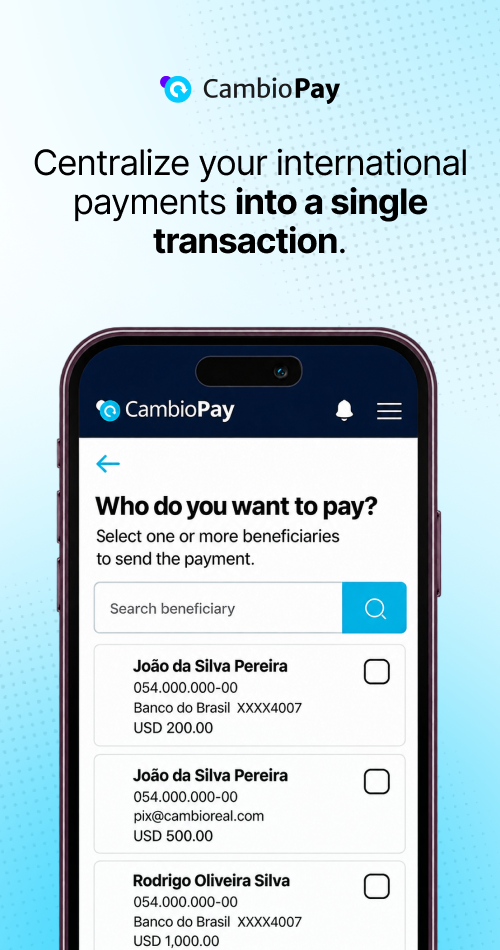
Instead of requiring companies to execute separate international transfers for every recipient, CambioPay allows businesses to organize multiple beneficiaries and fund their payments through a consolidated transaction. CambioReal then manages the distribution of the corresponding amounts to recipients in Brazil.
The model addresses several common problems for growing international teams:
- Batch payments: companies can organize multiple Brazilian recipients rather than manually rebuilding individual international transfers every month.
- Single funding transaction: the business can fund multiple payments through one consolidated USD transaction.
- Invoice and contract management: relevant payment documentation can remain associated with the company’s workflow instead of being scattered across emails and spreadsheets.
- Predictable recipient amounts: payments can be structured around the amount beneficiaries are expected to receive in BRL.
- No monthly membership fee: companies are not required to maintain a recurring software subscription simply to preserve access to the payment workflow.
- Bilingual support: U.S. companies and Brazilian recipients can receive assistance across English and Portuguese.
These capabilities are particularly relevant for businesses with recurring Brazilian payroll or contractor obligations. Companies can learn more about why U.S. companies use CambioPay for payments in Brazil.
Which Pix system should your company choose?
There is no universal payment architecture for every company selling into Brazil. The right system depends on where your business operates, where settlement needs to occur, how many transactions you process, and whether Pix represents a checkout method or one component of a broader financial operation.
A U.S. company already deeply integrated with Stripe may prioritize maintaining one global payment stack. A multinational operating across several emerging markets may require EBANX’s broader infrastructure, while a company with an established Brazilian entity may find Mercado Pago appropriate for domestic transactions.

Wise can serve specific transfer and BRL account workflows, although businesses should evaluate eligibility and checkout requirements carefully. Meanwhile, companies specifically seeking to collect Brazilian customer payments without creating local banking infrastructure can consider CambioCheckout as a purpose-built cross-border option.
The most important principle is to evaluate the complete movement of money rather than only the Pix transaction itself. Settlement, FX conversion, reconciliation, support, integration requirements, and finance-team workload ultimately determine whether a payment system remains efficient as Brazilian revenue grows.
Make Pix payments easier for your U.S. business
Pix can remove substantial friction from the Brazilian customer experience, but only when the infrastructure behind the transaction matches your international business model. The right solution should make local payment convenient for customers without transferring complexity to your accounting, finance, or operations teams.
CambioCheckout helps U.S. companies receive payments from Brazilian customers using familiar local methods while managing the cross-border path toward U.S. settlement. For businesses moving money in the opposite direction, CambioPay provides a dedicated workflow for recurring employee, contractor, and service-provider payments in Brazil.
Boost your sales in Latin America by offering local checkout with CambioCheckout!
Eliminate conversion barriers and provide the best shopping experience for your international customers. With CambioCheckout, your platform:
- Sells in dollars, and your end customers pay in their local currency using the payment methods they already trust;
- Increases conversion rates by reducing cart abandonment caused by international card fees;
- Processes Pix and local payments seamlessly and transparently directly on your page;
- Automates transactional workflows without the need to establish legal entities in each country across the region.