Expanding into Brazil creates a familiar problem for U.S. companies: closing the sale may be easier than collecting the money. Brazilian customers expect local payment methods, prices in reais, familiar checkout flows, and a payment experience that does not feel like an international wire transfer. When the payment stack cannot deliver that experience, finance teams face more than inconvenience. They can lose conversions, absorb unnecessary foreign-exchange costs, delay settlement, and create support problems that slow growth.
EBANX is one of the best-known cross-border payment providers serving Brazil and other emerging markets, and its current documentation shows support for methods including Pix, cards, and boleto. However, scale, integration model, commercial terms, settlement structure, and support requirements vary widely between providers. The right question is therefore not simply whether a platform can process Brazilian payments, but whether its economics and operating model fit the size, volume, technical resources, and expansion stage of your business.
For a U.S. company entering Brazil, the best alternative should solve three problems simultaneously: let customers pay locally, move funds internationally with predictable foreign-exchange handling, and keep finance operations simple enough to scale. This guide explains what to evaluate when comparing EBANX alternatives, where traditional methods create friction, and when CambioCheckout or CambioPay may fit different cross-border payment workflows.
Why Brazilian payments require a local strategy
Brazil is not a market where international cards alone create a complete checkout experience. Pix has become a core part of the country’s payment infrastructure, while boleto and locally issued cards remain relevant for different purchasing situations. The Central Bank of Brazil describes Pix as its instant payment system and maintains the regulatory framework governing its operation. Review the official Pix framework when evaluating providers that support Brazilian payments.
For U.S. merchants, the operational challenge begins after the customer chooses how to pay. The processor must collect BRL locally, reconcile the transaction, perform the necessary foreign-exchange operation, and settle the merchant in the agreed destination currency. Brazil’s foreign-exchange market is regulated by the Central Bank, and the current framework covers purchases and sales of foreign currency as well as international payments and transfers. Brazil’s current foreign-exchange rules therefore matter when a provider moves money across borders.
This distinction is important because a checkout can look simple while the financial infrastructure behind it remains complex. A provider may offer Pix but require a local entity, impose a settlement threshold, rely on a separate foreign-exchange process, or charge fees that become difficult to forecast as volume increases. For finance leaders, the objective should be a payment architecture that supports conversion without creating a second administrative problem after the sale.
What to compare before choosing an EBANX alternative
A meaningful comparison should go beyond the payment methods displayed on a pricing page. CFOs and operations leaders need to understand how each platform affects acquisition, cash flow, reconciliation, compliance, support, and engineering resources. A provider that appears inexpensive at the transaction level can still become costly if the business needs additional integrations, manual settlement work, or repeated customer support.
Before signing with a provider, compare the following areas:
- Local payment coverage: Confirm whether the platform supports Pix, boleto, and Brazilian cards for the exact customer journey your company needs.
- Settlement model: Understand whether funds can reach a U.S. bank account directly, which currencies are supported, and whether minimum withdrawal thresholds apply.
- FX transparency: Determine when the exchange rate is fixed, who absorbs the spread, and whether the merchant can predict the USD amount it will receive.
- Integration effort: Review API requirements, payment links, hosted checkout options, webhooks, documentation, and the engineering resources needed for launch.
- Customer support: Evaluate whether support is available in both English and Brazilian Portuguese, especially when a payment issue originates with the buyer.
- Reporting and reconciliation: Make sure finance teams can identify payment status, settlement amounts, refunds, and transaction history without rebuilding reports manually.
- Commercial commitments: Verify monthly fees, minimum volumes, setup costs, contractual commitments, and any charges that continue before Brazilian sales become predictable.
These criteria matter because a payment platform affects both customer experience and finance operations. Companies still validating Brazil may prioritize flexibility, while larger merchants may value advanced routing, local acquiring relationships, or multi-country scale.
The hidden costs of relying on traditional international payment methods
The simplest alternative to a specialized processor may appear to be an international wire or an international credit-card transaction. In practice, these methods often move complexity to the customer or the finance team. Buyers may face unfamiliar instructions, additional banking steps, foreign transaction charges, or payment methods that do not match how they normally purchase products and services in Brazil.

Traditional bank transfers also create reconciliation and timing issues at higher volume. Transactions can require manual identification, documentation, currency conversion, and follow-up, while settlement may depend on intermediary banks. Consequently, finance teams can spend substantial time matching payments instead of supporting growth.
International cards solve part of the checkout problem, but they do not eliminate the need for local payment preferences. A company selling SaaS, education, legal services, consulting, or high-ticket products may find that customers are willing to buy but hesitate when the only available option feels expensive or foreign. For a deeper explanation of the local payment flow, see how Pix payments can connect Brazilian buyers to U.S. businesses.
EBANX versus a more flexible market-entry model
EBANX currently provides payment infrastructure for Brazil and supports multiple local methods, making it relevant for companies seeking broad Latin American coverage. Its documentation also reflects a sophisticated platform approach designed for merchants that may need multiple payment rails and country-specific capabilities. That can be valuable for organizations with established transaction volume and engineering resources.
However, an enterprise-oriented platform is not automatically the best fit for every company entering Brazil. A startup testing demand or a professional-services firm billing a limited number of Brazilian clients may prioritize rapid onboarding and low fixed costs. Those businesses should compare the total operating model rather than select a provider based only on brand recognition.
Pricing should receive particular attention because public pricing is not always standardized across enterprise payment providers. Instead of relying on old comparisons or third-party estimates, request a current commercial proposal and model the cost at realistic monthly volumes. Include subscription charges, processing fees, FX spread, refund costs, settlement charges, engineering time, and any minimum commitments before comparing alternatives.
CambioCheckout as an alternative for receiving payments from Brazil
For U.S. companies accepting payments from Brazilian customers, CambioCheckout is the CambioReal product designed for that workflow. It allows businesses to offer local payment methods while receiving settlement abroad, without recreating a complete Brazilian payment operation internally. Receiving customer money is fundamentally different from paying contractors or suppliers.

CambioCheckout can support businesses that want to sell into Brazil without starting with a large fixed infrastructure commitment. Depending on the implementation, companies can use payment links or integrate a checkout flow into their own digital experience. This makes the product relevant for professional services, SaaS, education, e-commerce, and other businesses that want to test or expand Brazilian demand while preserving a U.S.-based financial operation.
The main advantages for a market-entry strategy include:
- local collection options designed around Brazilian payment behavior;
- settlement to the business outside Brazil;
- payment links for lower-technical-complexity use cases;
- API-based integration when a more automated checkout is required;
- bilingual support for merchant and payment-related questions;
- no need to make local payment collection a manual finance process.
The operational benefit is not simply offering Pix. It is connecting local collection, FX handling, transaction visibility, and settlement into one workflow. Companies comparing providers should also review how U.S. businesses can sell in Brazil and receive in dollars before deciding whether they need a local entity or a cross-border collection model.
Where CambioPay fits when your company sends money to Brazil
CambioPay addresses the opposite money flow. Instead of collecting from Brazilian customers, it is designed for businesses that need to pay professionals, contractors, employees, or suppliers in Brazil and other supported markets. Therefore, it should not be treated as a direct replacement for an acquiring or checkout platform when the primary requirement is accepting customer payments.
This distinction becomes especially useful for companies operating in both directions. A U.S. business may collect revenue from Brazilian customers through one workflow while also paying a Brazilian team, agencies, freelancers, or vendors through another. Using purpose-built products for each flow can reduce workarounds and create clearer reconciliation for finance teams.
How CambioPay reduces payout administration
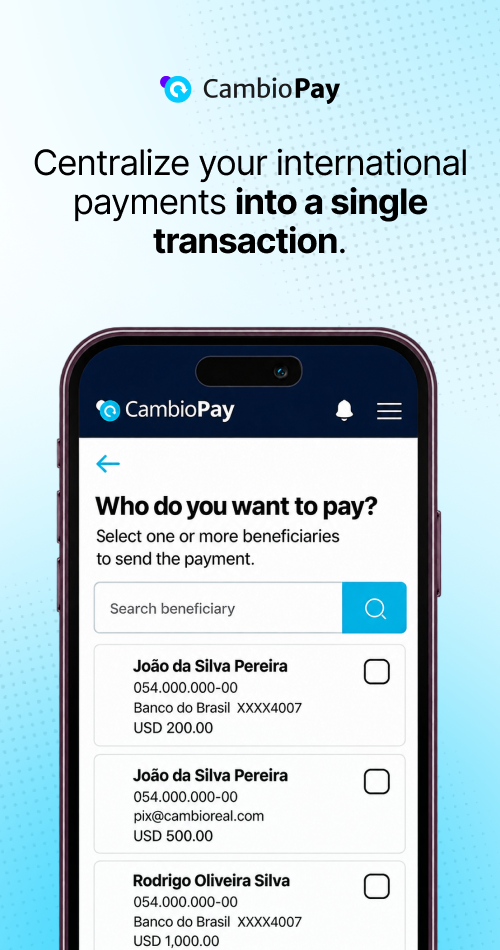
CambioPay is designed around recurring business payments rather than consumer remittances. Current CambioReal materials describe a pay-as-you-go structure with no monthly membership fee, support for multiple beneficiaries, spreadsheet imports for larger recipient lists, consolidated funding, local BRL delivery, reporting, and bilingual support. For finance teams, the practical value comes from replacing many repetitive international transfers with a more structured batch-payment process.
A typical operating model can look like this:
- The company creates and verifies its business account.
- Beneficiaries are added individually or imported in bulk.
- Contracts, invoices, or other required supporting information are organized within the payment workflow.
- Finance prepares multiple beneficiary payments and funds the transaction from the United States.
- CambioPay handles conversion and local distribution so recipients receive BRL in their Brazilian bank accounts.
- The company retains transaction and reporting records for reconciliation.
This model can reduce the number of separate international wires finance teams initiate every month. It can also improve predictability because the company sees the payment values and exchange-rate information before confirming the transaction. To evaluate this workflow in more detail, read why U.S. companies use CambioPay for payments in Brazil.
Documentation, invoices, and compliance still matter
Payment technology does not determine whether a worker should legally be classified as an employee, contractor, service company, or another relationship. That decision depends on the underlying legal and operational arrangement. Likewise, a payment processor can help organize transaction documentation, but it does not replace legal, tax, payroll, or accounting advice.
For cross-border payments, companies should keep contracts, invoices, beneficiary data, payment purpose, and reconciliation records aligned with their internal controls. Brazilian payment and foreign-exchange providers may request information because regulated international transfers require appropriate identification, transaction classification, and compliance procedures. The Central Bank has also updated its rules for international payment and transfer services, with Resolution BCB No. 561 scheduled to take effect on October 1, 2026. See the Central Bank’s 2026 update for the current regulatory direction.
How to choose the right provider for your Brazil strategy
The best provider depends on the money flow you are trying to simplify. If Brazilian customers need to pay your U.S. company, prioritize local checkout methods, conversion, settlement, refunds, integration, and buyer support. If your U.S. company needs to pay people or businesses in Brazil, prioritize beneficiary management, batch payments, documentation, FX visibility, local delivery, and finance reporting.
A practical evaluation process is to map one complete transaction from beginning to end. Identify who initiates the payment, which currency they use, what documentation is required, when the exchange rate is locked, where the money settles, who handles support, and how the finance team reconciles the transaction. Then compare providers using real monthly volumes rather than promotional headline rates.
For businesses still validating Brazil, fixed commitments and technical complexity deserve extra scrutiny because they increase the cost of experimentation. For companies already processing significant volume across Latin America, enterprise capabilities may carry more weight. The goal is not to choose the provider with the longest feature list, but the infrastructure that removes the most friction from your actual operating model.
A better payment strategy starts with the direction of funds
EBANX remains a relevant payment platform for companies operating in Brazil, but businesses should not assume that one provider or one product model fits every expansion strategy. The strongest alternative is the one that matches the direction of funds, supports Brazilian payment behavior, provides transparent settlement and FX processes, and does not force the finance team to build unnecessary manual workflows.
For receiving customer payments, CambioCheckout is the CambioReal solution aligned with local collection and international settlement. For paying teams, contractors, and suppliers, CambioPay focuses on consolidated business payouts, multiple beneficiaries, reporting, and local BRL delivery. Separating these two use cases gives CFOs a clearer framework for evaluating cost, compliance, scalability, and customer or beneficiary experience.
Boost your sales in Latin America by offering local checkout with CambioCheckout!
Eliminate conversion barriers and provide the best shopping experience for your international customers. With CambioCheckout, your platform:
- Sells in dollars, and your end customers pay in their local currency using the payment methods they already trust;
- Increases conversion rates by reducing cart abandonment caused by international card fees;
- Processes Pix and local payments seamlessly and transparently directly on your page;
- Automates transactional workflows without the need to establish legal entities in each country across the region.