Selling to customers in Brazil can look simple until the moment they need to pay your US company. An invoice may be clear, the customer may already be ready to buy, and your sales team may have completed every other part of the process correctly, yet the transaction can still become unnecessarily difficult when the only available options were designed around the US banking system.
This friction has a direct business cost. Brazilian customers may need to deal with an international card, foreign banking instructions, currency conversion, transfer fees, or payment processes that feel considerably more complicated than a regular domestic purchase. Consequently, payment localization becomes part of the customer experience rather than a purely financial decision.
Pix solves an important part of that problem. Developed within Brazil’s financial infrastructure, Pix allows customers to complete local electronic payments quickly through their banks, while a cross-border payment provider can handle the conversion and settlement required to deliver the funds to a US business. The result is a simpler experience for the customer and a more structured collection process for the merchant.
Why Pix matters for US companies selling in Brazil
Pix is Brazil’s instant payment system and operates within the framework established by Banco Central do Brasil. The payment network allows transfers and payments to be initiated at any time, including weekends and holidays, making it fundamentally different from payment methods tied to traditional banking hours. Businesses evaluating the Brazilian market can consult the official Pix framework from Banco Central do Brasil for the regulatory and operational foundations of the system.
However, the strategic value of Pix goes beyond transaction speed. Brazilian customers are already accustomed to opening their banking app, scanning a QR code or using a Pix Copy and Paste code, confirming the amount, and authorizing the transaction. That familiarity reduces the number of unfamiliar steps between purchase intent and payment completion.
For a US company, this creates an important localization opportunity. Translating a website into Portuguese or advertising to Brazilian audiences does not fully localize the buying journey if checkout still requires customers to adapt to a foreign payment system. Offering local payment methods allows the financial experience to match the rest of the commercial experience.
Businesses that need a more detailed overview of the infrastructure can read our complete guide to how Pix works in Brazil, which explains how the payment method is used within the Brazilian market.
The real cost of forcing customers into international payments
A payment method should make it easier to complete a purchase, not introduce a new decision after the customer has already decided to buy. Nevertheless, international transactions often add several layers of friction immediately before checkout.
A Brazilian customer paying a US company may have to think about whether a card accepts international transactions, how much the final amount will be after currency conversion, whether additional banking charges apply, and how long a traditional transfer will take. Some customers may complete those steps anyway, but every additional requirement increases the operational burden and creates another point where the transaction can stall.
The merchant faces similar complications on the opposite side. Finance teams need to understand which invoice was paid, how much the customer originally paid in BRL, what exchange rate was used, when the payment will settle, and how much will ultimately arrive in USD.

Therefore, the relevant comparison is not simply Pix versus another payment method. It is a comparison between a localized payment workflow and an international process that asks the customer and merchant to solve more of the financial complexity themselves.
How a cross-border Pix payment actually works
Pix is fundamentally a domestic Brazilian payment system, which means a US company still needs infrastructure capable of connecting the local transaction to an international settlement. The merchant cannot simply place a personal Pix key on a US checkout and expect the money to arrive automatically in an American bank account.
A specialized cross-border provider creates that bridge. Although the exact workflow depends on the provider, the transaction generally follows a structure such as:
- The US company creates a payment request or checkout.
- The customer sees the transaction amount converted into Brazilian reais.
- The system generates a Pix QR code or Copy and Paste code.
- The customer authorizes the payment through a Brazilian financial institution.
- The payment is processed locally in BRL.
- The provider handles the foreign-exchange and international settlement process.
- The corresponding funds are transferred to the company’s US bank account.
This structure allows the customer-facing side of the transaction to remain local while the financial infrastructure behind it manages the international component. For companies that want a more technical walkthrough, our step-by-step guide to integrating Pix payments explains payment links, QR code generation, FX conversion, and settlement in greater detail.
Because the transaction ultimately involves currency conversion and cross-border settlement, companies should also understand the broader Brazilian foreign-exchange framework. Banco Central do Brasil provides an overview of its official foreign-exchange policy and regulatory structure, which helps explain why a compliant international payment flow involves more than simply receiving a domestic Pix transfer.
Pix versus international cards and bank transfers
Pix should not necessarily replace every other payment option. Instead, the strongest checkout strategy generally gives Brazilian customers access to payment methods that reflect how they actually prefer to transact.
International credit cards
Cards remain useful for customers who already have international purchasing enabled and prefer credit-based payment options. They are also deeply integrated into global e-commerce infrastructure, which makes them difficult to eliminate entirely.
Nevertheless, an international-card-only strategy can introduce authorization issues, foreign transaction costs, exchange-rate uncertainty, and card-network dispute processes. For customers who simply want to pay from their Brazilian bank balance, the card adds an additional financial layer that may not be necessary.
Pix approaches the transaction differently. Instead of relying on the customer’s international card, the payment begins through a Brazilian banking relationship the customer already uses.
Traditional international bank transfers
International wires can still make sense for larger B2B invoices, particularly when both companies already have treasury procedures for cross-border transactions. However, they are usually less convenient for routine consumer purchases or smaller commercial invoices.
Customers may need international banking instructions, beneficiary information, SWIFT details, and additional bank procedures. Settlement may also take longer, while intermediary or recipient-bank charges can make the final cost less predictable.
Pix allows the local payment portion to happen much more naturally. The provider then handles the conversion and international transfer rather than requiring the customer to organize that movement independently.
Pix is different from card chargebacks, but not irreversible
One important issue deserves clarification because older discussions about Pix sometimes oversimplify it. Pix does not operate through the same commercial chargeback framework used by credit-card networks, but that does not mean a Pix payment can never be returned.
Banco Central do Brasil maintains the Mecanismo Especial de Devolução, or MED, which supports the recovery of funds in eligible situations involving fraud, scams, or certain operational problems. The Banco Central explanation of the MED process also makes clear that the mechanism is specifically structured around qualifying Pix situations rather than ordinary card-style commercial disputes.
For merchants, the more accurate advantage is therefore that Pix has a different payment and dispute architecture from cards. Marketing the method as completely irreversible would oversimplify the actual regulatory framework.
Where CambioCheckout fits into the payment process
CambioCheckout is designed for the inbound side of the transaction: Brazilian customers paying a company based outside Brazil. Instead of requiring the customer to organize an international payment directly, the platform creates a localized checkout where the customer can pay in BRL using options such as Pix, boleto, or a Brazilian card.
The US company, meanwhile, receives its settlement in USD rather than having to manage a Brazilian bank balance and arrange the cross-border transfer separately. CambioReal’s current materials also describe automatic US settlement and a model without a monthly subscription for the merchant.
This model is particularly relevant for companies testing the Brazilian market because it reduces the need to build a large financial infrastructure before revenue is established. A business can begin with payment links for more manual sales processes and later move toward API-based integration when transaction volume increases.
There are several operational advantages worth considering:
- Local checkout: Brazilian customers complete the transaction through familiar domestic payment methods.
- USD settlement: The merchant receives funds in the United States instead of managing BRL separately.
- Payment flexibility: Pix can operate alongside boleto and Brazilian card payments.
- Integration options: Businesses can use payment links or connect the checkout through an API.
- Lower fixed overhead: The current CambioCheckout positioning does not require a merchant subscription.
These features matter because localization should not create a second administrative problem for the finance team. The ideal infrastructure simplifies the customer’s payment without forcing the merchant to manually rebuild the international settlement process afterward.
Receiving money is only half of a Brazil strategy
As a US company expands in Brazil, financial complexity frequently begins moving in both directions. The company may receive payments from Brazilian customers while simultaneously hiring Brazilian developers, designers, consultants, sales representatives, or other service providers.
This creates a different challenge. CambioCheckout solves the inbound flow, while paying professionals in Brazil requires an outbound payment structure capable of managing beneficiaries, currency conversion, documentation, and recurring transactions.
Finance teams often solve this initially with a combination of wires, spreadsheets, email, cloud folders, and individual payment tools. That approach may work for two contractors, but it becomes increasingly inefficient when a company has ten, thirty, or fifty people to pay.
A more scalable financial architecture separates these two questions clearly:
- How should Brazilian customers pay our US company?
- How should our US company pay people and vendors in Brazil?
The first can be addressed through CambioCheckout. The second is where CambioPay becomes relevant.
How CambioPay solves recurring payment friction
CambioPay is designed around companies that need to send payments from the United States to teams, freelancers, contractors, or other beneficiaries in Brazil. Its purpose is not to replace CambioCheckout but to solve the opposite financial movement.
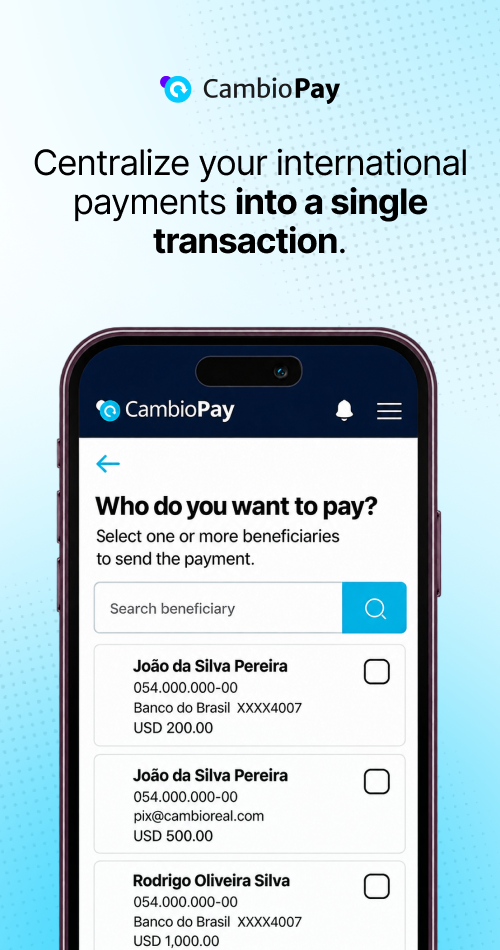
Traditional international payment processes become expensive partly because every recipient may generate another transaction, another set of banking instructions, another reconciliation task, and another opportunity for delay. CambioPay changes that operating model by allowing businesses to register multiple beneficiaries and fund their payments from a consolidated US transaction. CambioReal then manages the local distribution in BRL.
Batch payments reduce repetitive finance work
A company paying 25 Brazilian professionals should not have to recreate an international transfer 25 times every month. Beneficiaries can be registered individually or in bulk, allowing the finance team to organize the payment run before funding the total operation.
This reduces repetitive banking work and creates a more standardized monthly process. Furthermore, CambioReal states that recipients can receive the specified BRL amount in their local Brazilian accounts without opening a separate global account.
No subscription fee makes scaling more flexible
Many global HR and payment platforms bundle payments with broader software suites and monthly subscriptions. Those platforms can be appropriate for companies that need a complete HR or Employer of Record environment, but they can be excessive when the primary requirement is moving money efficiently.
CambioPay currently operates without a monthly membership fee and uses a pay-as-you-go structure, allowing companies to scale payments without adding another fixed software subscription.
Invoice workflows reduce documentation fragmentation
Payments to Brazilian contractors often need to be associated with agreements, beneficiary details, and service invoices. When those records are scattered across email, spreadsheets, and banking portals, finance teams spend additional time matching documents to transactions.
CambioPay helps centralize beneficiary and payment documentation within the operating workflow. This does not replace professional tax, accounting, or worker-classification advice, but it can reduce the administrative work surrounding recurring payments.
Brazilian service providers may also need to issue NFS-e depending on their business structure and applicable requirements. The Brazilian government describes the national NFS-e as an electronic document used to formalize the provision of services.
Predictable BRL amounts improve payment planning
Currency conversion introduces another source of uncertainty when a US company agrees to pay a Brazilian professional a specific amount. If the contract is denominated in BRL, the finance team needs to know the USD cost required to deliver that amount. If compensation is denominated in USD, the recipient still needs visibility into the resulting BRL payment.
CambioPay allows payment amounts to be defined in USD or BRL and presents the conversion within the payment workflow. This creates greater predictability for budgeting while reducing the likelihood of the recipient receiving less than expected because of unclear conversion mechanics.
What CFOs should evaluate before choosing a Brazil payment solution
The most visible fee rarely represents the complete cost of an international payment system. CFOs should evaluate not only transaction pricing but also the administrative effort required to maintain the process every month.
A useful evaluation should consider:
- Total cost: FX spread, transfer charges, subscriptions, settlement fees, and banking costs.
- Customer experience: Whether Brazilian buyers can use familiar local payment methods.
- Recipient experience: Whether team members need new accounts or additional financial apps.
- Batch capabilities: Whether increasing headcount creates proportionally more manual transactions.
- Reconciliation: Whether finance can easily connect payments, beneficiaries, and supporting records.
- Support: Whether both the US company and Brazilian users can obtain help when a transaction requires attention.
This framework makes it easier to distinguish a low transaction fee from an actually efficient cross-border payment process. A system that saves a few dollars per payment but creates hours of manual reconciliation may still be the more expensive choice operationally.
Build the payment experience around the Brazilian market
Offering Pix is not simply a matter of adding another payment logo to checkout. It is a way of reducing the financial distance between a Brazilian customer and a US company.
For businesses selling into Brazil, CambioCheckout can localize the customer-facing transaction while preserving USD settlement in the United States. For companies that also hire Brazilian professionals or pay local service providers, CambioPay addresses the opposite flow by centralizing beneficiaries, batch payments, currency conversion, and recurring operational documentation.
Together, these workflows illustrate a broader principle for international expansion: customers and teams should not have to fight against foreign banking infrastructure simply because the company is headquartered in another country.
A successful cross-border payment strategy makes the transaction feel local where it needs to feel local, while keeping the company’s financial operation manageable from the United States.
READY TO MAKE PAYMENTS BETWEEN THE US AND BRAZIL EASIER?
Boost your sales in Latin America by offering local checkout with CambioCheckout!
Eliminate conversion barriers and provide the best shopping experience for your international customers. With CambioCheckout, your platform:
- Sells in dollars, and your end customers pay in their local currency using the payment methods they already trust;
- Increases conversion rates by reducing cart abandonment caused by international card fees;
- Processes Pix and local payments seamlessly and transparently directly on your page;
- Automates transactional workflows without the need to establish legal entities in each country across the region.