Moving money internationally may seem straightforward when viewed only as a transfer between two bank accounts. However, when companies pay suppliers, contractors, agencies, or teams abroad, the transaction also involves currency conversion, transaction classification, documentation, and regulatory controls.
An incorrect classification can delay settlement, trigger additional documentation requests, or create reconciliation problems later. Furthermore, treating every international transfer the same way can force finance teams into unnecessary manual workflows, especially when dozens of beneficiaries need to be paid every month.
In Brazil, these operations are governed by the foreign exchange framework established by Law No. 14,286/2021 and related Central Bank regulations. As a result, companies should move away from outdated explanations based on former numbered contract types and understand how foreign exchange transactions work under the current rules.
What is a foreign exchange contract?
In practical terms, a foreign exchange transaction occurs when one currency is bought or sold through an institution authorized to operate in Brazil’s foreign exchange market. This may happen when a U.S. company converts dollars into Brazilian reais to pay a supplier, or when a Brazilian business converts local revenue into another currency.
Brazil’s current legal framework is primarily based on Law No. 14,286/2021, often referred to as the new foreign exchange legal framework, together with Central Bank regulations. The Brazilian foreign exchange law establishes the general rules governing these transactions, including the requirement that operations be conducted through institutions authorized by the Central Bank of Brazil.
Consequently, the current concept is broader than simply signing a document called a foreign exchange contract. The transaction must contain enough information to identify the parties, amounts, currencies, purpose, exchange rate, settlement dates, and other elements required for proper registration and execution.
This distinction matters because many older resources still refer to ten fixed categories of foreign exchange contracts numbered from one to ten. That structure belonged to a previous regulatory model and no longer reflects how businesses should interpret current foreign exchange operations.
What information is included in a foreign exchange transaction?
Central Bank Resolution No. 277 defines the minimum information associated with foreign exchange operations. Therefore, the institution processing the transaction must record enough data to demonstrate how the funds were converted, what the declared purpose was, and who participated in the payment.
According to the current Central Bank regulations for foreign exchange operations, this information may include customer identification, the currency traded, the foreign currency amount, the exchange rate, the equivalent amount in BRL, the settlement date, and the purpose of the transaction.
In practice, a business transaction may include information such as:
- identification of the authorized institution handling the transaction;
- identification and qualification of the customer;
- foreign currency used in the transaction;
- amount expressed in foreign currency;
- corresponding amount in Brazilian reais;
- exchange rate applied to the transaction;
- expected settlement date;
- economic purpose of the payment;
- identification of the payer or recipient abroad when required;
- supplementary information based on the characteristics of the transaction.
These data points make the transaction traceable for financial and regulatory purposes. They also help finance and accounting teams maintain consistent records of international payments, beneficiaries, converted amounts, and settlement details.
Does every international transfer require the same documentation?
No. This is one area where outdated explanations about foreign exchange can create unnecessary confusion because different transactions have different economic purposes and may require different levels of information or supporting documentation.
A company may move money internationally to buy goods, purchase services, pay software providers, compensate contractors, or transfer funds between related companies. Each operation should reflect its actual economic purpose rather than simply being classified as a generic international transfer.
The Central Bank uses specific codes and categories for these purposes. For certain transactions up to USD 50,000, for example, simplified categories can cover purchases and sales of goods, computer services, business services, transfers between accounts held by the same person, and other economic purposes.
Therefore, transaction value should never be considered in isolation. The source of funds, relationship between the parties, underlying purpose, and characteristics of the payment can all influence the information needed to process the transaction correctly.
For companies working with Brazilian contractors or service providers, understanding the underlying business relationship also helps organize the payment flow. Our guide to outsourcing to Brazil and its laws and regulations explains how contracts, payment structures, and service arrangements may interact.
Who determines the purpose of the transaction?
Under the current framework, the customer is responsible for correctly identifying the purpose of the foreign exchange transaction. However, the authorized institution should provide technical guidance when there is uncertainty about the appropriate classification.
This means a finance team should not simply select the closest available category to process a payment faster. Incorrect classification can create inconsistencies between commercial agreements, invoices, accounting records, and the financial transaction itself.

For example, a U.S. company paying a Brazilian marketing agency every month is carrying out an economically different transaction from a company importing physical merchandise. Likewise, transferring funds between related entities differs from paying an independent supplier for professional services.
Creating clear internal procedures for transaction classification can consequently reduce rework and improve financial records. This becomes increasingly important when payment volume increases and similar transactions need to be processed every month.
What documents may be requested?
There is no single list of documents that applies identically to every foreign exchange transaction. An authorized institution may request information based on the customer’s profile, the characteristics of the payment, and its internal risk assessment.
The Central Bank explains that documentation required for foreign exchange transactions may vary depending on these factors and on controls associated with anti-money laundering and counter-terrorist financing requirements.
For a business, potentially relevant documentation may include:
- Corporate documents: Company registration records and information about authorized representatives.
- Commercial agreements: Contracts demonstrating the business relationship between the payer and beneficiary.
- Invoices or tax documents: Evidence of the service, product, or obligation generating the payment.
- Financial records: Documents demonstrating the source or availability of funds when necessary.
- Beneficiary information: Banking and registration details associated with the individual or company receiving payment.
The better these records are organized, the less operational friction finance teams are likely to experience. Centralizing documentation also makes future reconciliations, compliance reviews, and audits easier to manage.
How does an international business payment work?
Although the exact process varies according to the institution and the purpose of the payment, an international business transaction generally begins by identifying the payer and beneficiary. The business then determines the value, currency, economic purpose, and supporting documentation required.
Afterward, the institution presents the applicable foreign exchange conditions. The company can review the rate, fees, and expected amount received before confirming and funding the transaction.
A structured international payment flow typically follows these steps:
- company onboarding and verification;
- beneficiary registration or identification;
- definition of payment amount and currency;
- classification of the transaction purpose;
- submission of required supporting documents;
- presentation and acceptance of exchange conditions;
- funding of the international transaction;
- conversion between currencies;
- settlement into the beneficiary’s account;
- recording the operation for reconciliation.
This workflow becomes considerably more important when a company moves from occasional international transfers to paying ten, twenty, or fifty professionals every month.
Where do foreign exchange costs come from?
The cost of an international business payment should not be evaluated only by looking at the transfer fee advertised by a provider. Depending on the solution, multiple cost components can influence both the amount the company spends and the amount received by the beneficiary.
The first component is the exchange rate itself, which determines the conversion between currencies. Companies should also consider the foreign exchange spread because it represents the margin incorporated into the commercial exchange rate offered for the transaction.
Transfer fees, intermediary banking charges, and applicable taxes may also affect the final cost, depending on the payment structure. Consequently, CFOs should evaluate the total cost of the transaction instead of comparing providers based on one visible fee.
Operational costs deserve equal attention. Creating dozens of transfers individually, tracking confirmations, correcting beneficiary information, and reconciling payments across multiple systems can consume substantial finance-team resources even when banking fees initially appear competitive.
For businesses that also need to collect payments originating in Brazil, our guide to receiving money from Brazil in the United States explains the main operational considerations involved in the opposite payment direction.
Why do recurring payments make foreign exchange more complex?
A company that pays one international supplier several times per year can generally manage the process manually without significant difficulty. The situation changes when dozens of professionals, agencies, developers, or other service providers must receive payments every month.
Every new beneficiary can create additional banking details, contracts, invoices, amounts, confirmations, and reconciliation tasks. Furthermore, processing each international transfer separately increases opportunities for typing errors, duplicate payments, and discrepancies between contracted amounts and final settlements.
At this stage, optimizing foreign exchange means more than obtaining a competitive exchange rate. The business must also reduce the number of manual tasks required to transform a contractor or supplier payment file into transactions successfully settled in Brazil.
How CambioPay simplifies international payments
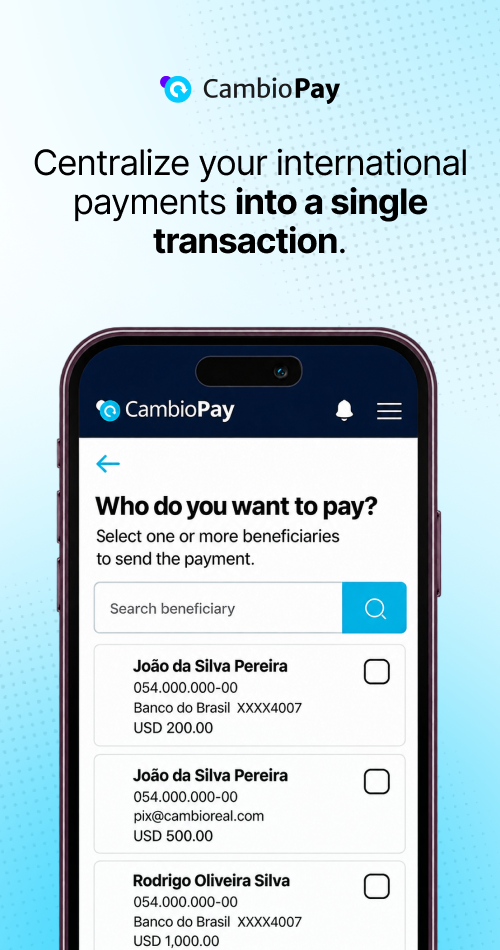
CambioPay is designed for U.S. companies that need to pay professionals, contractors, and suppliers in Brazil and other Latin American markets. Rather than creating multiple international wires individually, companies can manage several beneficiaries within one centralized payment workflow.
This approach changes the operational burden on finance departments. Businesses can register multiple recipients, import larger payment lists through spreadsheets, manage information centrally, and fund the payment process while Brazilian beneficiaries receive BRL directly into their local bank accounts.
Relevant capabilities for finance teams include:
- zero monthly subscription fees;
- support for multiple beneficiaries;
- spreadsheet-based bulk payment workflows;
- exchange-rate visibility before confirmation;
- local settlement in BRL for Brazilian recipients;
- centralized contracts and invoices associated with payments;
- financial reporting and payment tracking;
- support available in English and Portuguese;
- API integration possibilities for specific business requirements.
CambioPay does not replace commercial contracts, HR platforms, legal advice, or the company’s tax responsibilities. Instead, its role is to organize and execute the international payment flow while reducing repetitive administrative tasks associated with moving funds between countries.
This distinction matters for CFOs evaluating international payment infrastructure. Companies that require employee benefits, workforce management, or employment services may need additional platforms, while businesses primarily struggling with cross-border payment execution may prefer a more specialized solution.
For companies comparing different options, our guide to the best payroll and payment software for Brazil explains how different models approach recurring international payments.
Consolidated payments can reduce finance workload
The operational advantage becomes particularly clear when several beneficiaries are involved. Instead of preparing an independent international wire for every recipient, the company can organize multiple payments together and fund the process through a more consolidated workflow.
As a result, finance teams reduce the number of banking instructions they need to create, review, monitor, and reconcile. Distribution to individual beneficiaries can then happen through the payment platform, creating a more scalable process for recurring payments.
Documentation stays connected to the transaction
Contracts and invoices remain important because they support the economic purpose behind each payment. However, keeping these records within a centralized workflow makes them considerably easier to manage when a business continuously works with multiple professionals and suppliers.
This structure also improves traceability. Instead of keeping beneficiary information in one spreadsheet, invoices in another folder, and payment records across several bank portals, finance teams can create a more consistent process for managing international transactions.
Checklist before completing a foreign exchange transaction
Before confirming an international business payment, companies can reduce avoidable problems by reviewing several essential elements. This type of control becomes particularly useful for recurring payments and higher-volume international operations.
- Confirm the identity of both the payer and beneficiary.
- Identify the correct economic purpose of the transaction.
- Verify that contracts and invoices are current and consistent.
- Compare the amount sent with the amount expected by the beneficiary.
- Review the exchange rate and all additional transaction costs.
- Confirm beneficiary banking details before settlement.
- Store payment records and confirmations for reconciliation.
- Centralize recurring payments when doing so reduces manual work.
This process does not eliminate regulatory checks or institutional requirements. However, it creates an internal structure that makes international payment operations more predictable as transaction volume and beneficiary numbers increase.
Foreign exchange should not become a business bottleneck
Brazil’s foreign exchange market has evolved, and companies should not manage cross-border payments according to rules or processes belonging to an earlier regulatory framework. Today, the priority is correctly identifying the parties, classifying the economic purpose, maintaining consistent documentation, and working with an authorized institution capable of processing the transaction appropriately.
For CFOs and finance teams, the challenge increases when international payments stop being occasional transactions and become part of monthly operations. At that stage, reducing individual transfers, centralizing beneficiary management, and organizing supporting documents can generate as much operational value as negotiating a competitive exchange rate.
CambioPay brings these activities into a payment workflow designed for U.S. businesses paying professionals and suppliers in Brazil, without monthly subscription fees and with support for multi-beneficiary payments.
Simplify your international financial operations with CambioReal!
Centralize foreign exchange management, payments, and receivables in Latin America into a single integrated platform. With CambioReal, your company:
- Connects international markets by sending and receiving funds in multiple local currencies;
- Eliminates middlemen and bureaucracy through an agile financial ecosystem with zero subscription fees;
- Ensures regulatory compliance with end-to-end legal security and support for local tax rules;
- Optimizes cash flow by monitoring exchange rates in real time and scheduling strategic transactions.