Wise can be a convenient way to move money internationally. However, paying one contractor occasionally is very different from managing recurring payments for an entire team in Brazil.
As the number of employees, contractors or service providers grows, international payroll introduces additional layers of work. Finance teams need to coordinate payment dates, exchange rates, beneficiary information, invoices, contracts, transaction records and local banking requirements, often while working across multiple systems.
At that point, the question is no longer simply whether a platform can transfer USD to BRL.
The more useful question becomes whether the payment process can support your company every month as the Brazilian operation grows.
For U.S. businesses comparing alternatives to Wise for payroll in Brazil, this guide explains what to evaluate beyond transfer fees and why a platform designed around recurring business payments may provide a better fit.
Why a money transfer app may not be enough for international payroll
International money transfer platforms solve an important problem: moving funds between currencies and countries. And for occasional transfers, that may be exactly what a company needs.
Payroll, however, is repetitive by nature.
Every month, the finance team needs to know who will receive money, how much each person should receive, which exchange rate will be applied, whether documentation is complete and whether every payment reached the correct beneficiary. And this difference becomes increasingly noticeable as the team grows.
A company paying one Brazilian consultant may be comfortable initiating a transfer manually. A company paying 30 or 50 professionals every month has a different operational challenge because the same steps need to be repeated across dozens of recipients.
For that reason, companies comparing Wise alternatives should look beyond the ability to send money and evaluate how well the entire payment workflow scales.

The limitations of traditional money transfer apps for full-scale payroll
Wise and similar services can be useful tools, but a platform built primarily around money movement may not address every operational requirement of international payroll. The limitations often become more visible in four areas:
1. Payroll requires recurring organization, not isolated transfers
An isolated international payment has a beginning and an end, payroll does not. Companies need to repeat the process every month while maintaining consistent beneficiary information, payment schedules, documentation and financial records.
If every cycle begins with recreating payment instructions, confirming bank details and gathering information from several sources, the finance team spends time rebuilding a process that should already be standardized. A more scalable payroll workflow should make recurring payments easier rather than simply making each individual transfer possible.
2. Individual transfers create more administrative work as teams grow
Consider a U.S. company paying 25 professionals in Brazil, if every person requires a separate payment workflow, the company may need to:
- verify 25 beneficiaries;
- enter or confirm 25 payment amounts;
- process multiple transactions;
- organize invoices and supporting documents;
- monitor whether every beneficiary received the payment;
- reconcile multiple transaction records afterward.
The cost of payroll therefore includes more than banking fees, it also includes the time required to execute and control the process. Batch payments can reduce this friction by allowing the finance team to prepare several recipients within the same payroll operation instead of treating every beneficiary as an entirely separate international process.
3. The cheapest visible fee may not mean the lowest payroll cost
Transfer fees are easy to compare because they appear directly on a pricing page or transaction screen, but other costs are less obvious. Currency exchange spreads, intermediary charges, software subscriptions and employee time can all increase the real cost of paying an international team.
For example, if a finance professional spends several hours every month gathering payment information, resolving beneficiary problems and reconciling transfers, that administrative workload should also be considered when comparing platforms. Our guide to how much your Brazilian team is actually costing every month explores how these less visible expenses can influence total payroll costs.
4. Support becomes more important when payments are recurring
A delayed personal transfer is inconvenient, but in the other side, delayed payroll affecting an entire team creates a much larger problem. When employees or contractors are expecting payment on a specific date, unresolved banking or documentation questions can affect trust and create additional work for HR and finance teams.
This is one reason businesses should evaluate not only how a payment platform works when everything goes correctly, but also what happens when something goes wrong.
The accounting challenge: payroll involves more than sending money
Cross-border payroll sits between several business processes. Finance needs transaction records. Contractors may need to submit invoices. HR may need information about who should be paid. Accounting needs to reconcile expenses. Management wants predictable costs.
When those activities happen across several disconnected platforms, companies can experience what might be called multi-software friction.
- One tool manages payments.
- Another stores contracts.
- Invoices arrive by email.
- Beneficiary information lives in a spreadsheet.
- Accounting records exist somewhere else.
None of those systems is necessarily a problem individually. The difficulty comes from repeatedly moving information between them.
Contracts and invoices need to match the payment workflow
For contractor and B2B relationships, the payment generally exists because a service was provided under an agreement. That means contracts and invoices should not be treated as completely separate from payroll administration.
Before a payment is approved, the company may need to confirm:
- which service period the payment covers;
- which contractor or company issued the invoice;
- whether the payment amount matches the agreement;
- which entity should receive the funds;
- which payroll cycle the transaction belongs to;
- whether supporting documentation has been collected.
- When these records are organized alongside the payment process, reconciliation becomes easier.
- When they are scattered across email threads, spreadsheets and separate subscription tools, every payroll cycle creates additional administrative work.
Hidden software fees can change the economics of international hiring
One of the advantages of hiring internationally can be access to talent and different cost structures.
However, those advantages become less attractive when every new operational need adds another monthly software bill.
A company may start with a payment platform and eventually add tools for contracts, contractor management, global HR and reporting.
For large organizations requiring extensive HR infrastructure, those expenses may be justified.
For smaller companies, the economics can be different.
If your business already knows how the team is structured and mainly needs to pay several Brazilian beneficiaries every month, a large subscription-based global employment platform may offer functionality that the company does not actually use.
That is why pricing models deserve attention when comparing alternatives to Wise.
The relevant question is not only:
“How much does this transfer cost?”
It is also:
“How much will our entire payroll stack cost every month?”
Delayed international salaries create a people problem, not just a finance problem
Payroll efficiency has consequences beyond accounting.
When an international transfer arrives late, employees and contractors may not care whether the cause was an intermediary bank, missing document, internal approval issue or payment platform.
They simply know they did not receive the money when expected.
Repeated payment problems can affect confidence in the company and create unnecessary conversations between employees, managers, HR and finance teams.
This is why building processing time into the payroll schedule is important.
It is also why choosing a payment method designed around recurring business payments can matter as the team grows.
If your company has already experienced payment delays, our guide to avoiding delayed salaries for international teams [INTERNAL LINK: Are You Delaying Salaries for Your International Team? Stop Now] explains why predictable payroll should become part of the operating process.
Why bilingual support matters for U.S.-Brazil payroll
Imagine a beneficiary notices a problem with their bank information.
Without localized assistance, the issue may travel through several people:
- the Brazilian professional contacts their manager;
- the manager contacts HR;
- HR contacts finance;
- finance contacts the payment provider;
- the answer travels through the same chain in reverse.
That is an inefficient use of everyone’s time.
When both the company and the recipient can access specialized support in their preferred language, issues can be resolved with less internal coordination.
CambioReal currently provides digital assistance in English and Portuguese through channels including chat, email and WhatsApp.
For companies managing remote teams, that localized assistance can become particularly valuable because payroll problems are resolved closer to the people actually involved.
Our article on the role of CambioPay in managing remote teams in Brazil [INTERNAL LINK: The Role of CambioPay in Managing Remote Teams in Brazil] explores this operational side in greater detail.
What should you look for in an alternative to Wise for payroll?
There is no universal payment platform that fits every company.
A business sending an occasional payment to one Brazilian consultant has different requirements from a company paying dozens of professionals every month.
When evaluating alternatives, consider whether the solution supports the workflow you actually need.
1. Batch payment capabilities
If the team is growing, the ability to organize several beneficiaries in one payment process becomes increasingly important.
The objective is to reduce the amount of repetitive work required each payroll cycle.
2. Predictable currency conversion
Companies should understand the exchange rate before completing payroll whenever possible.
This is particularly important when compensation is predetermined in BRL because exchange-rate fluctuations change how many dollars the U.S. company must fund.
3. Beneficiary management
Re-entering recipient information every month wastes time and increases the possibility of mistakes.
A recurring payroll solution should make previously verified beneficiaries easier to reuse.
4. Documentation organization
Contracts, invoices and payment records need to remain accessible for accounting and internal controls.
The easier these records are to associate with payment cycles, the easier reconciliation becomes.
5. Transparent pricing
Look beyond the transfer fee.
Consider exchange rates, subscription fees, intermediary costs and additional software your company may need to maintain around the payment platform.
6. Processing time
A low-cost solution is not particularly useful if payments consistently arrive later than expected.
Payroll requires predictability.
7. Support for the company and recipient
Cross-border support becomes considerably more valuable when both sides can communicate in their preferred language.
For U.S.-Brazil operations, English and Portuguese support can reduce unnecessary internal coordination.
CambioPay: a business-focused alternative for recurring payments to Brazil
CambioPay was created around a different use case from a typical consumer money-transfer application: helping businesses send recurring payments from the United States to beneficiaries in Brazil.
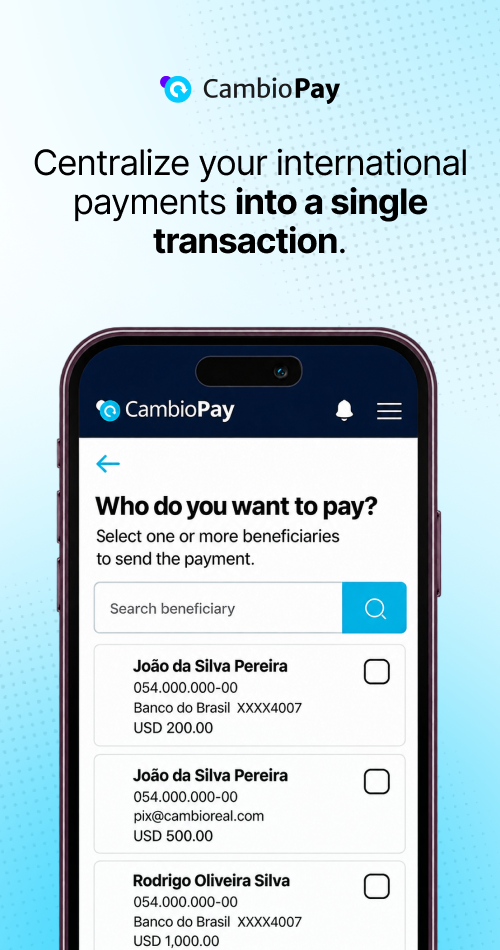
The platform allows companies to organize multiple recipients and fund payments through a consolidated operation rather than treating every beneficiary as an unrelated international transfer. CambioReal currently describes CambioPay as supporting a single U.S. ACH or Wire Transfer that can then be distributed to multiple beneficiaries in Brazil.
For finance teams, the objective is straightforward: reduce the repetitive operational work involved in international payroll.
Pay multiple people through one workflow
Instead of preparing an independent international transfer for each person, businesses can organize their beneficiaries and send the necessary funds through a consolidated transaction.
This becomes increasingly valuable as the team grows because administrative effort no longer needs to increase at the same rate as the number of recipients.
Upload beneficiary information using spreadsheets
For larger payrolls, entering recipients individually can become another repetitive task.
CambioPay supports uploading payee information through spreadsheets, making it easier to prepare larger groups of beneficiaries.
Fund payments through ACH or Wire Transfer
U.S. companies can fund the transaction using U.S. banking methods such as ACH or Wire Transfer, depending on the operation.
Once confirmed, the funds can be converted and distributed locally to Brazilian bank accounts.
Know what your team will receive
Currency uncertainty can make payroll budgeting difficult.
CambioPay allows the exchange rate to be defined before the transaction, helping companies understand how much they are funding and how much beneficiaries will receive in local currency.
No monthly software subscription
Another important difference for companies evaluating payroll tools is the cost model.
CambioReal states that account creation is free and that there is no monthly maintenance fee, with costs associated with processed transactions or currency conversion instead.
That can be particularly relevant for businesses that need international payment infrastructure without adding another recurring software subscription to their stack.
Bilingual assistance for both sides of the payment
CambioReal offers specialized support in English and Portuguese, helping both U.S. businesses and Brazilian beneficiaries navigate payment questions.
For remote teams, this means finance managers do not necessarily need to become the intermediary for every beneficiary question.
CambioPay is not an Employer of Record
Companies should also understand what CambioPay does not replace.
An Employer of Record, commonly called an EOR, typically provides a broader employment structure and may formally employ workers on behalf of another company.
CambioPay focuses on the payment side of the operation.
Therefore, if your company still needs to determine whether Brazilian workers should be employees, contractors or another type of service provider, that decision should come first.
However, when the relationship has already been established and the primary challenge is sending recurring payments efficiently, using a specialized cross-border payment platform can prevent the business from paying for HR or employment functionality it does not need.
Wise vs. a payroll-focused payment workflow
The key difference is not necessarily whether one platform can transfer money and the other cannot.
Both may be capable of moving funds internationally.
The distinction is the operational context.
| Money transfer approach | Payroll-focused approach |
|---|---|
| Optimized around transfers | Optimized around recurring team payments |
| Useful for individual recipients | Designed to handle multiple beneficiaries |
| Each transfer may be treated separately | Payroll can be organized as a recurring workflow |
| Cost evaluated primarily per transfer | Cost considered across the full payroll process |
| Support centered on the transaction | Support can include employer and beneficiary needs |
| May require additional tools around payroll | Seeks to reduce operational fragmentation |
For a business sending money occasionally, the first model may be sufficient.
For a company managing a growing team in Brazil, the second may become more efficient because it addresses the process around the transaction rather than only the transfer itself.
When does switching from Wise make sense?
Moving to another payment workflow does not need to happen simply because your company reaches a certain number of employees.
Instead, look for operational signals.
It may be time to evaluate alternatives when:
- finance spends too much time creating individual international payments;
- beneficiary information needs to be gathered repeatedly;
- payroll reconciliation is becoming difficult;
- several software subscriptions are required to support the process;
- employees or contractors regularly ask about payment status;
- language differences are making support harder;
- unpredictable exchange rates complicate budgeting;
- payment delays are beginning to affect the team;
- the company plans to increase its number of Brazilian beneficiaries.
Any one of these issues may be manageable.
Several happening together usually indicate that international payroll has outgrown a simple money-transfer workflow.
Simplify recurring payroll payments to Brazil with CambioPay
International payroll becomes difficult when companies try to solve a recurring business process with a collection of disconnected tools and individual transfers.
The goal should not simply be to move money from USD to BRL.
A scalable process should help the company organize beneficiaries, reduce repetitive transfers, understand currency conversion, maintain payment records and provide support when either side needs assistance.
CambioPay was designed around that recurring cross-border payment workflow.
U.S. companies can organize multiple Brazilian beneficiaries, fund the operation through ACH or Wire Transfer, distribute payments locally in BRL and access bilingual support without adding a monthly software subscription.
For businesses that have outgrown individual international transfers, this can turn payroll from a monthly administrative burden into a more predictable financial process.
Ready to simplify payments to your Brazilian team? Create your CambioPay account or talk to the CambioReal team to understand how batch payments can fit your operation.
Pay your international team with ease and low fees using CambioPay!
Centralize payments for employees, freelancers, contractors, and suppliers across Latin America in a single operation. With CambioPay, your company:
- Pays in dollars, and your contractors receive it in their local currency;
- Reduces manual processes and gains more control over international workflows;
- Receives low-rate alerts in real time;
- Schedules payments strategically based on the day’s exchange rate.