Outsourcing to Brazil is real, and has become an attractive destination for companies looking to expand their teams, outsource business processes or work with specialized professionals abroad. From software development and IT to customer service, design, marketing and administrative services, Brazilian professionals can support companies without requiring every operation to be located in the same country.
However, outsourcing to Brazil involves more than finding professionals and sending international payments. Companies should understand how Brazilian labor laws distinguish employees, independent contractors and outsourced workers, as well as the responsibilities that may arise from each arrangement.
For foreign companies, the key is choosing a structure that reflects how the professional will actually work. In this guide, we explain the main laws, regulations and practical considerations involved in outsourcing to Brazil.
What does outsourcing to Brazil mean?
Outsourcing to Brazil can describe several different arrangements. A foreign company may contract a Brazilian company to perform specific services, work directly with an independent contractor established as a Brazilian legal entity, hire professionals through a local structure or use another employment arrangement.
These models should not be treated as interchangeable, the correct structure depends on factors such as:
- the services being provided;
- how much control the company exercises over the worker;
- whether the relationship is continuous;
- who manages the professional;
- how compensation is structured;
- whether the professional operates independently;
- where the contracting company is established.
Understanding these distinctions is especially important because Brazilian law generally evaluates the reality of the working relationship rather than relying exclusively on the title used in a contract.
Is outsourcing legal in Brazil?
Yes. Brazilian legislation expressly allows companies to outsource activities. Law No. 6,019/1974, as amended by Laws No. 13,429/2017 and 13,467/2017, establishes rules for temporary work and the provision of services to third parties.
The legislation defines outsourcing as the transfer of the execution of activities from the contracting company to a private service provider with the economic capacity to perform them. Importantly, the law allows companies to outsource any of their activities, including their core business activities.
This interpretation was also reinforced by Brazil’s Federal Supreme Court. In its decisions involving ADPF 324 and RE 958252, the Supreme Federal Court recognized the legality of outsourcing activities regardless of whether they are considered core or ancillary activities.
Therefore, the old distinction between outsourcing a company’s “core activity” and “non-core activity” should no longer be used as the main test for determining whether outsourcing itself is permitted.
What is the difference between outsourcing, contractors and employees in Brazil?
This is one of the most important distinctions for international companies and human resorces: Hiring a Brazilian professional as an independent contractor is not necessarily the same thing as outsourcing employees through another company.
Outsourced workers
In a traditional outsourcing arrangement, a company hires another legal entity to perform specific services. Under Brazilian outsourcing legislation, the service provider is responsible for hiring, compensating and managing its workers.
The contracting company should therefore pay attention to how responsibilities are divided between the parties. Brazilian law also establishes subsidiary liability for the contracting company regarding certain labor obligations during the period in which the outsourced services are provided.
Independent contractors or PJs
Another common model involves contracting a Brazilian professional through a legal entity, commonly referred to in Brazil as a PJ, or Pessoa Jurídica. In simple terms, this means that the contractor operates as a business and issues invoices for the services provided. However, PJ is not a specific type of company. Brazilian contractors can operate under different business structures depending on their revenue, profession and how their business is organized.
One of the simplest structures is the MEI, or Microempreendedor Individual. It was created for small individual businesses and offers simplified registration and taxation. However, not every contractor can use it.
Key factors determining whether a professional can remain an MEI or needs a different business structure:
- Annual revenue: as of 2026, the standard MEI revenue limit is R$81,000 per year. If the business grows beyond the applicable limits, the contractor may need to leave the MEI regime and operate under another business classification.
- Type of professional activity: only activities included in Brazil’s official list of permitted MEI occupations qualify for this structure. Certain professional and specialized services cannot be registered as MEI.
- Number of employees: a standard MEI can employ only one worker. A contractor who needs a larger team generally needs another company structure.
- Business ownership: an MEI cannot be a partner, owner or administrator of another company and cannot maintain a branch.
- Type of business activity and invoicing: the contractor’s registered activity determines important tax and invoicing requirements. Service providers, for example, generally issue an electronic service invoice, known as an NFS-e, while businesses involved in commerce or other activities can be subject to different registration and invoicing requirements.
- Growth of the business: as revenue, operations or staffing increase, a professional may transition from MEI to another structure, such as a Microempresa (ME), which can accommodate a larger operation.
How the Brazilian MEI and PJ Work
For an American company, the easiest way to understand this is that two Brazilian contractors performing similar work may legally operate under different business structures. One may qualify as an MEI, while another may need a larger company structure because of their annual revenue, professional activity or business organization.
Brazil’s government currently sets the standard MEI annual revenue ceiling at R$81,000, although a proposal to increase that threshold is under discussion and has not yet taken effect. The government also maintains an official list of occupations that may operate under the MEI regime.

For service providers, Brazil also has a national electronic service invoice system, the NFS-e, which formalizes the provision of services and is used by MEIs when applicable.
Therefore, a foreign company should not require every Brazilian contractor to open an MEI. Instead, the contractor’s business registration should be compatible with the professional activity, revenue and structure of their operation.
CLT employees
CLT refers to the Consolidação das Leis do Trabalho, Brazil’s main body of employment legislation. Article 3 of the Brazilian Consolidation of Labor Laws defines an employee as an individual who provides non-eventual services to an employer, under the employer’s direction and in exchange for compensation.
Formal employment can trigger several labor obligations and protections. Brazil’s Constitution establishes rights including:
- FGTS;
- 13th salary;
- paid annual vacation;
- limits on ordinary working hours;
- overtime protections;
- weekly paid rest;
- maternity and paternity protections;
- social security-related rights.
The exact obligations depend on the employment structure and applicable legislation or collective bargaining agreements.
Can a U.S. company hire independent contractors in Brazil?
Foreign companies can enter into service agreements with Brazilian businesses and independent professionals. However, creating a contractor agreement does not by itself guarantee that the relationship will always be treated as an independent business relationship.
The practical characteristics of the relationship matter. Under Article 3 of the CLT, employment status involves elements such as services performed by an individual, continuity, compensation and dependence or subordination.
For that reason, a company should carefully evaluate how a Brazilian contractor actually performs their work. For example, potential compliance concerns may become more relevant when a contractor is treated operationally in substantially the same way as an employee.
This is why companies outsourcing to Brazil should distinguish between contracting a service and simply labeling an employment-like relationship as a contractor arrangement.
What is “pejotização” in Brazil?
When researching outsourcing in Brazil, international companies may encounter the term pejotização. The expression comes from “PJ”, or Pessoa Jurídica.
It generally refers to situations in which services are provided through a legal entity rather than through a traditional employment agreement. However, discussions about pejotização often involve an important legal question: whether the arrangement represents a genuine business relationship or whether the circumstances could indicate an employment relationship.
The Brazilian Supreme Court has recognized the legality of outsourcing and other forms of division of labor between separate legal entities. Nevertheless, companies should still structure contracts and day-to-day working relationships carefully.
The safest approach is not simply asking whether a contractor has a CNPJ. Companies should also evaluate how the relationship actually operates.
What should an outsourcing contract in Brazil include?
A written agreement helps establish responsibilities between the parties and provides documentation for the commercial relationship. Depending on the arrangement, an outsourcing or contractor agreement may address:
- Scope of services
Clearly describe the services or deliverables expected from the Brazilian provider. - Payment terms
Define compensation, payment frequency, currency, deadlines and invoicing requirements. - Responsibilities of each party
Specify which party manages employees, contractors, equipment, expenses and other operational obligations. - Confidentiality
Companies handling confidential business information should define how that information may be accessed, stored and shared. - Intellectual property
Software, designs, content and other intellectual property created during the relationship should have clear ownership provisions. - Data protection
If personal data is processed, the agreement may need provisions addressing Brazil’s data protection requirements. - Termination conditions
The contract should explain how either party may end the commercial relationship and what happens to outstanding payments, documents and confidential information.
Contract requirements can vary significantly depending on the service and relationship. Legal counsel familiar with Brazilian and cross-border contracts can help companies evaluate their specific situation.
Does Brazil have data protection laws?
Yes. Brazil has its own comprehensive data protection framework known as the Lei Geral de Proteção de Dados Pessoais (LGPD).
Law No. 13,709/2018 establishes rules regarding the processing of personal data, including collection, storage, use, sharing and other processing activities. The LGPD is particularly relevant when outsourced teams have access to information involving customers, employees, users or other individuals.
Companies working with Brazilian providers may therefore need to consider:
- what personal data contractors can access;
- why the data is being processed;
- where information is stored;
- security measures;
- responsibilities of controllers and processors;
- international data transfers;
- procedures for data incidents.
Companies already familiar with Europe’s GDPR will recognize several similar concepts, although the two legal frameworks should not be treated as identical.
Does a foreign company need to open a company in Brazil to outsource work?
Not necessarily. A foreign company can contract services from Brazilian companies or independent service providers without automatically establishing its own Brazilian subsidiary simply because it purchases services from Brazil. IMB itself invest in outsourcing in brazil.
However, the appropriate structure depends on the nature of the operation.
There is an important difference between purchasing independent services from Brazil and establishing an operation that may create local corporate, employment or tax obligations.
Companies planning to maintain a substantial presence in Brazil should therefore obtain professional advice about potential corporate and tax consequences.
For businesses that only need to pay independent professionals and suppliers, cross-border service relationships may offer a considerably simpler structure.
You can also read our guide about payroll and payments for teams in Brazil.
Do outsourced workers receive Brazilian employment benefits?
It depends on the relationship.
Workers formally employed by a Brazilian outsourcing company generally have an employment relationship with that service provider and receive the protections applicable to their employment.
Independent businesses and contractors operate under a different legal framework.
That is why companies should avoid treating “outsourced worker”, “independent contractor” and “employee” as synonyms.
Before outsourcing to Brazil, determine which relationship actually represents the work being performed.
What is temporary work in Brazil?
Temporary work is another specific category under Brazilian law and should not be confused with ordinary outsourcing.
According to Brazil’s Ministry of Labor and Employment, temporary work involves an individual hired by a registered temporary employment company and made available to another company to cover temporary replacement needs or complementary demand for services.
The model is regulated primarily by Law No. 6,019/1974 and additional regulations.
Consequently, hiring an independent Brazilian contractor for a project does not automatically mean that the person is a “temporary worker” under Brazilian labor law.
What taxes apply when outsourcing to Brazil?
Taxes depend heavily on the structure used.
A Brazilian company providing services to a foreign client may have Brazilian tax, accounting and reporting obligations according to its legal form, tax regime, activity and the nature of the transaction.
A foreign company with its own Brazilian operation may face a completely different set of obligations.
Therefore, there is no universal “outsourcing tax” that applies to every company hiring professionals in Brazil.
This is another reason companies should determine the legal structure of the relationship before calculating the actual cost of outsourcing.
How should U.S. companies pay contractors in Brazil?
After contracts and compliance are organized, companies still need a reliable way to move money from the United States to Brazil.
Traditional international wire transfers can create additional administrative work when a company has several Brazilian beneficiaries.
Instead of organizing separate international transfers for every contractor or service provider, companies can use a payment platform designed specifically for cross-border payments.
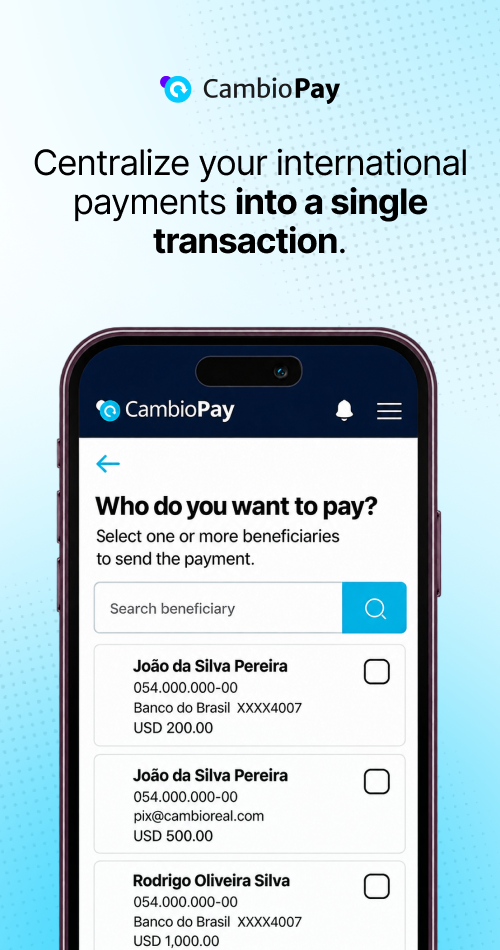
With CambioPay, U.S. companies can manage payments to multiple beneficiaries in Brazil through a consolidated process.
Companies can:
- register multiple Brazilian beneficiaries;
- manage payment information in one place;
- send a consolidated payment;
- pay beneficiaries locally in Brazilian reais;
- reduce repetitive international transfer processes;
- receive bilingual support in English and Portuguese.
You can learn more about this process in our guide on managing remote teams in Brazil with CambioPay.
Checklist before outsourcing to Brazil
Before starting an outsourcing relationship, review these points:
- Determine whether you need an employee, contractor or outsourcing provider.
- Confirm that the professional’s business structure is compatible with the services being provided.
- Prepare a written service agreement.
- Define deliverables and responsibilities clearly.
- Establish payment terms and currency.
- Review intellectual property provisions.
- Evaluate LGPD requirements when personal data is involved.
- Keep contracts, invoices and payment records organized.
- Avoid managing independent contractors exactly like employees.
- Review possible Brazilian tax and employment implications.
- Choose an efficient method for making cross-border payments.
For larger teams, periodically reviewing these relationships can also help identify whether the company’s original outsourcing structure still reflects how the team operates.
Is outsourcing to Brazil worth considering?
Brazil offers foreign companies access to professionals across technology, marketing, design, customer support, finance and many other business functions.
At the same time, successful outsourcing requires more than simply hiring someone abroad.
Companies need to understand whether they are working with an independent contractor, an outsourcing provider or an employee and structure contracts, management processes and payments accordingly.
Brazilian law permits outsourcing, including the outsourcing of core business activities. However, employment rules, data protection requirements and contractual responsibilities remain relevant.
Once the appropriate structure is established, the next challenge is making cross-border payments efficiently.
Pay your international team with ease and low fees using CambioPay!
Centralize payments for employees, freelancers, contractors, and suppliers across Latin America in a single operation. With CambioPay, your company:
- Pays in dollars, and your contractors receive it in their local currency;
- Reduces manual processes and gains more control over international workflows;
- Receives low-rate alerts in real time;
- Schedules payments strategically based on the day’s exchange rate.