Hiring suppliers in different countries allows businesses to expand their operations and find qualified professionals. However, managing international payments can become challenging as the number of contracts and recipients increases. Therefore, organizing transfers, monitoring foreign exchange costs, and maintaining financial records are essential steps toward better expense management.
For US companies working with suppliers and teams in Latin America, these challenges are part of everyday financial operations. After all, each payment may involve different currencies, banking deadlines, and recipient information. In this context, establishing a structured international supplier payment process helps reduce manual tasks and improve financial predictability.
What Are the Challenges of International Supplier Payments?
International supplier payments involve more steps than transfers between accounts within the same country. In addition to confirming amounts and dates, businesses must consider currency conversion, fees, and banking conditions. When multiple recipients are involved, these activities can significantly increase administrative workloads.
Imagine a US company hiring developers in Brazil, designers in Mexico, and consultants in Colombia. Each professional may have different contracts, payment currencies, and due dates. Consequently, the finance team must manage several obligations without losing visibility into costs.
The challenge increases when companies use disconnected tools to manage this information. Contracts may be stored in shared folders, approvals handled through emails, and payment confirmations scattered across banking platforms. As a result, locating the history of a particular transfer may require several searches and verifications.
Therefore, financial control should begin before funds are transferred. Businesses need to organize contracts, establish approval procedures, and define how each transaction will be monitored. This makes international payments a structured process, even as operations expand.
How to Organize Supplier Contracts and Information
The first step is maintaining an updated database of all international suppliers. This record should include contractual details, banking information, and payment conditions. Additionally, businesses should identify who is responsible for approving each expense.
An efficient system should also distinguish contracted amounts from payments that have already been completed. After all, suppliers may receive monthly payments, project-based compensation, or payments tied to specific deliverables. Therefore, linking each transaction to its corresponding contract helps prevent financial discrepancies.
Another important consideration involves the documentation required to justify payments. Depending on the transaction, businesses may need invoices, service confirmations, and other contractual documents. Keeping these records accessible simplifies audits, financial reviews, and internal procedures.
What Information Should Supplier Records Include?
A centralized supplier database should allow finance teams to quickly locate each recipient’s information. It should also simplify the verification of obligations before funds are transferred. Consider recording the following details:
- Supplier’s name or registered business name.
- Country of residence or business registration.
- Banking details and receiving currency.
- Contract number or identification.
- Contracted amount and payment terms.
- Due dates and responsible approvers.
- Invoices, payment confirmations, and transaction history.
With this information organized, businesses can reduce their dependence on requests to different departments. Additionally, they can identify missing documents before initiating transfers. This structure also supports operational continuity when finance team members change.
In our article about outsourcing to Brazil and its regulations, we discuss important considerations when hiring international service providers. Although the content focuses on Brazil, the importance of proper documentation also applies to other markets. However, businesses must evaluate each country’s specific regulations according to their contractual relationships.
How to Control Foreign Exchange Costs in International Transfers
Currency exchange is an important variable in international supplier payments. Even when companies maintain fixed-value contracts, the amount required to complete a transfer may change. This happens when the budgeting currency differs from the currency established for payment.
The International Trade Administration, part of the US Department of Commerce, highlights risks associated with currency fluctuations. According to the organization, exchange rate movements can affect the financial results of international operations. Therefore, businesses should understand their foreign exchange exposure before making recurring payments.

Imagine a US company that needs to pay a Mexican supplier in pesos. If the contract establishes a fixed amount in local currency, the cost in dollars may change with exchange rates. As a result, a predictable expense for the supplier may fluctuate within the paying company’s budget.
Conversely, contracts denominated in US dollars may transfer part of the exchange rate exposure to the recipient. In this case, the amount received in local currency depends on the applicable conversion conditions. Therefore, defining contractual currencies and foreign exchange responsibilities helps prevent discrepancies.
What Should Businesses Consider When Calculating Total Transfer Costs?
Comparing only a provider’s advertised fee does not necessarily reveal the total transaction cost. Depending on the solution, foreign exchange margins and recipient charges may also apply. Additionally, processing times can influence the choice of payment method.
The World Bank explains that international remittance costs may include fees, exchange rate margins, and recipient charges. Although its research primarily monitors smaller remittances, these criteria help explain how transfer costs are calculated. Therefore, businesses should compare the amounts actually sent and received.
Before approving a transfer, finance teams should verify the applicable exchange rate and associated costs. They should also confirm the final amount that will be available to the supplier. This allows companies to assess transaction conditions more transparently.
How to Track International Payments Without Losing Control
Tracking transfers is essential for businesses working with multiple recipients. After all, initiating a payment does not necessarily mean the supplier has received the funds. Therefore, finance teams should monitor each transaction until completion.
A good practice is establishing clear stages for every payment. Companies can distinguish submitted requests, approved expenses, initiated transfers, and completed payments. This gives each transaction a status that simplifies monitoring.

Additionally, responsible team members should quickly identify pending transactions or payments requiring corrections. Incorrect banking information and additional verification procedures may affect processing. Therefore, maintaining updated records helps resolve problems without disrupting the entire financial workflow.
Standardize Payment Approval Procedures
Businesses should also define who can request, approve, and execute international payments. Separating these responsibilities helps reduce errors and unauthorized transactions. Furthermore, companies can establish approval requirements according to transaction amounts and characteristics.
For higher-value payments, for example, an additional approval may be necessary. Recurring expenses, meanwhile, can follow a previously established procedure. This allows finance teams to maintain control without rebuilding the process for every transfer.
Why Is Financial Reconciliation Important?
Financial reconciliation allows businesses to compare their payment records with transactions that have actually been completed. This process helps verify whether transferred amounts match approved expenses. Additionally, it allows finance teams to identify duplicate transfers, currency discrepancies, and pending transactions.
International payment reconciliation requires particular attention to currencies and conversion rates. After all, the amount deducted from a business account may differ from the amount received by the beneficiary. Therefore, maintaining records of exchange rates, fees, and transaction dates makes verification easier.
The IFRS Foundation provides guidance for accounting for foreign currency transactions under IAS 21. The standard addresses currency conversion and the recognition of exchange rate effects. Therefore, companies should consider applicable accounting standards when recording international transactions.
How to Organize an Efficient Reconciliation Process
The first step is linking each payment to the document that originated the expense. Next, finance teams should compare approved amounts with the transfer details. Finally, they should record any discrepancies and confirm that the transaction was completed.
This process can follow a weekly or monthly schedule, depending on transaction volume. However, businesses processing numerous payments may benefit from more frequent reviews. This allows discrepancies to be identified while the information is still recent.
In our article about payroll in Brazil for US companies, we explain how to organize records and reconcile recurring transfers. Although the content focuses on professional teams, the same principles can guide supplier payments. Both require documentation, monitoring, and financial control.
Can Batch Payments Reduce Manual Processes?
Businesses working with numerous suppliers may spend considerable time preparing individual transfers. Each transaction requires recipient information, amount verification, and payment monitoring. When these activities are repeated dozens of times, administrative workloads increase.
Batch payments allow companies to organize multiple transfers within a consolidated process. Instead of preparing a separate international transaction for each supplier, businesses can group recipients and payment amounts. This reduces repetitive tasks and simplifies payment execution.
This approach can benefit technology companies, agencies, consulting firms, and businesses working with internationally distributed professionals. Additionally, it simplifies operations involving recurring payments on similar dates. Therefore, batch processing can support supplier network growth without requiring an equivalent increase in manual work.
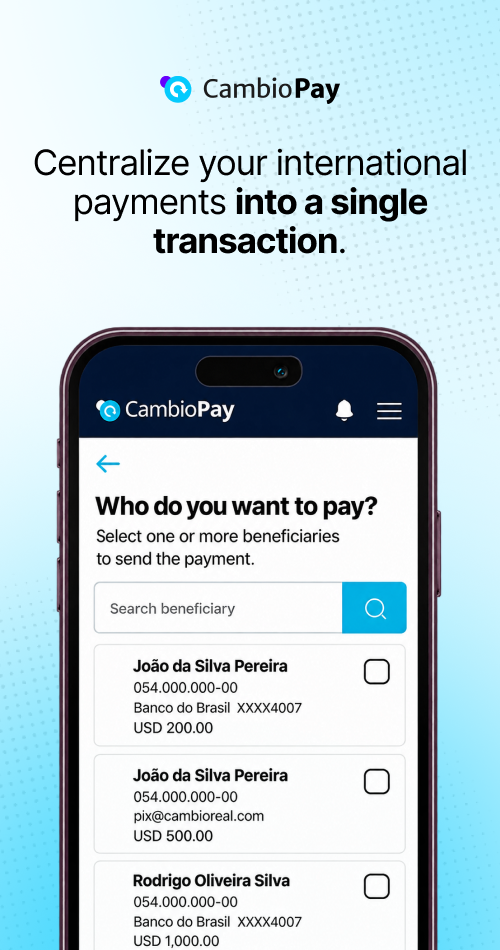
With CambioPay, US businesses can import spreadsheets containing information for multiple recipients. The platform supports batch payments and distributes funds to local bank accounts in supported countries. As a result, finance teams do not need to initiate each international transfer separately.
How Does CambioPay Simplify International Supplier Payments?
CambioPay was developed for US businesses that need to pay teams, freelancers, and suppliers across Latin America. The platform provides tools for organizing recipients, processing transfers, and tracking international payments. This allows businesses to simplify financial activities associated with their service providers.
The solution currently supports payments to Brazil, Mexico, and Colombia. Recipients receive funds directly into local bank accounts in the currencies supported for each market. Additionally, they do not need to create an account or install an application to receive payments.
Centralized Recipient and Payment Management
With CambioPay, businesses can register recipients individually or import lists through spreadsheets. This functionality simplifies the management of operations involving multiple suppliers. Additionally, it reduces the need to repeatedly enter information during each payment cycle.
The platform allows companies to fund transactions from the United States through available methods, including ACH and wire transfers. Funds are then distributed to recipients according to the applicable processing conditions. This allows businesses to manage different payments through a consolidated workflow.
Greater Foreign Exchange Predictability
Another CambioPay feature is the ability to define amounts in US dollars or local currencies. Businesses can review the conversion conditions applicable to each transaction before confirming payment. This helps clarify how exchange rates influence the amounts sent and received.
For recurring contracts, this functionality can simplify financial planning. Finance teams can compare projected expenses with the costs displayed on the platform. This reduces uncertainty surrounding currency conversion when payments are processed.
Payment Tracking and Financial Records
CambioPay also provides digital transfer tracking and records of completed transactions. The platform makes information available to help identify recipients, amounts, and payment statuses. Consequently, finance teams gain greater visibility into the movement of funds.
Additionally, transaction reports can support payment documentation and financial reconciliation. This reduces the need to search multiple platforms for payment information. However, companies remain responsible for maintaining their own accounting and contractual controls.
In our D4U Immigration case study, we explain how the company used CambioPay to improve its international payment operations. The article explores challenges related to team growth and transfer organization. It also demonstrates how a specialized solution can reduce operational difficulties when working with professionals across different countries.
How to Evaluate an International Payment Solution
Before choosing a platform, businesses should identify their specific operational needs. The number of suppliers, supported countries, and transfer frequency all influence this decision. Additionally, companies should consider costs and transaction monitoring features.
A suitable solution should simplify payment execution without compromising financial visibility. Therefore, businesses should compare features related to recipient management, exchange rate transparency, and documentation. It is also important to verify which currencies and transfer methods are available.
In our article about alternatives to Wise for paying teams in Brazil, we analyze criteria for comparing international payment platforms. These include costs, processing times, and features for recurring operations. The same considerations can help businesses managing supplier payments across different markets.
Checklist to Improve Financial Control Over International Suppliers
After identifying the main challenges, businesses should establish a routine for organizing their transfers. The goal is to keep information accessible, reduce repetitive tasks, and monitor costs transparently. Use the following checklist as a reference.
- Keep supplier contracts and banking information updated.
- Define the currency and payment conditions for each contract.
- Maintain a calendar with due dates and approval deadlines.
- Assign responsibility for requesting and authorizing expenses.
- Verify exchange rates and costs before confirming transfers.
- Consider batch payments for operations involving multiple recipients.
- Monitor transfer statuses until receipt is confirmed.
- Link each payment to its corresponding invoice or document.
- Perform financial reconciliation regularly.
- Monitor costs and the performance of international payment operations.
These practices help businesses establish more organized financial workflows. Additionally, they make it easier to identify problems before they affect future payments. Over time, companies can adapt their processes as supplier networks and transaction volumes grow.
Gain Greater Control Over International Supplier Payments With CambioPay
International supplier payments require organization, monitoring, and careful attention to foreign exchange costs. However, managing these activities does not have to mean processing dozens of individual transfers and maintaining disconnected financial records. With structured procedures, businesses can reduce manual tasks and improve expense visibility.
With CambioPay, US companies can centralize payments to suppliers, freelancers, and teams in Brazil, Mexico, and Colombia. The platform provides batch payments, currency conversion, and transfer monitoring through a digital environment. This allows finance teams to spend less time on repetitive activities while maintaining greater control over their operations.
Pay your international team with ease and low fees using CambioPay!
Centralize payments for employees, freelancers, contractors, and suppliers across Latin America in a single operation. With CambioPay, your company:
- Pays in dollars, and your contractors receive it in their local currency;
- Reduces manual processes and gains more control over international workflows;
- Receives low-rate alerts in real time;
- Schedules payments strategically based on the day’s exchange rate.