Brazil has held a relevant position in the technology operations of major international companies for decades. International Business Machines Corporation (IBM) is one example of a multinational that invested in the country both to serve the local market and to develop technology-related operations and services.
Over the years, the company has participated in billion-dollar contracts, maintained service centers in the country, and worked with Brazilian professionals across different IT areas. Therefore, analyzing IBM’s trajectory helps explain some of the reasons why IT outsourcing in Brazil became an alternative for international companies.
In addition to the availability of technology professionals, factors such as location, the structure of the IT sector, and the possibility of building specialized teams contributed to the development of this market. In this article, I will explain the reasons that led IBM to invest in Brazil and how CambioPay can be a solution for other companies looking to enter the Brazilian market.
What is IT outsourcing?
IT outsourcing is the practice of delegating certain technology activities to an external company or team. In this model, an organization can transfer specific functions to outside specialists instead of building the entire structure internally.
For example, outsourcing may include:
- Software development;
- Web and application development;
- IT infrastructure;
- Server administration;
- Technical support;
- Cloud computing;
- Information security;
- Systems management;
- Technology-related business processes.
Therefore, outsourcing does not necessarily mean transferring the entire IT department to another company. In many cases, an organization keeps an internal team while outsourcing only certain operations or projects that require specific expertise.
IBM and outsourcing in Brazil: a decades-long relationship
In 2012, IBM signed one of the most important agreements related to its operations in the Brazilian technology market. The company entered into a US$1 billion agreement with EBX Group to take over the Brazilian conglomerate’s IT operations and invest in its technology division.

The contract established that EBX would pay IBM US$1 billion over a ten-year period to manage these operations. In addition, the partnership involved IBM acquiring a 20% stake in SIX Automação and creating a research and development joint venture.
As a result, the agreement went beyond hiring isolated technology services. In practice, it represented a broader partnership between the companies and reinforced the importance of the Brazilian market to IBM’s strategy at that time.
IBM had already invested in outsourcing in Brazil before 2012
IBM’s outsourcing activities in the country began before this billion-dollar contract. In 2003, for example, the company entered into an agreement with Brazilian telecommunications company Embratel.
According to ZDNet, the project reduced certain IT costs related to the operation by approximately 30%. Therefore, years before the growth of remote work, Brazil was already emerging as a relevant market for technology operations and services.
Later, new opportunities emerged as companies began operating with increasingly distributed teams.
Why is IT outsourcing in Brazil a business strategy?
Several factors can make Brazil attractive to international companies looking for technology professionals or service providers. Naturally, lower costs are part of this analysis; however, they represent only one factor. The availability of specialized professionals, the structure of the IT market, and the time-zone proximity to the United States can also influence this decision.
1. A large number of specialized technology professionals
The Brazilian market has professionals working across different areas of technology, from software development to infrastructure, data, support, and cloud computing. Consequently, foreign companies can access specific expertise without necessarily developing all of these capabilities within their own teams.
In addition, outsourcing allows companies to expand a team according to the needs of each project. A company developing a new product, for example, can add developers or other specialists during a specific stage. Afterward, the structure can be reorganized according to business needs.
2. Exchange-rate differences between the U.S. dollar and Brazilian real can benefit both sides
Another relevant factor for U.S. companies is the difference between the U.S. dollar and the Brazilian real. Depending on the economic environment and the type of professional hired, this exchange-rate relationship can create cost structures that differ from those found in the U.S. market.
However, comparing salaries alone does not show the total cost of the operation. Companies also need to consider professional experience, hiring models, taxes, international payments, tools, and other administrative costs. Therefore, the goal should be to analyze the total cost of outsourcing rather than currency conversion alone.
3. Time zones close to the United States
In addition, Brazil offers an important operational advantage compared with outsourcing destinations located much farther from the United States: time zones. Depending on the location of the U.S. company, professionals in both countries can work simultaneously during a significant portion of the business day.
As a result, meetings, task tracking, problem-solving, and communication between teams can take place with a smaller time difference. This factor is especially important for projects that require constant collaboration among professionals.
Remote work expanded outsourcing in Brazil
The growth of remote work happened alongside a broader expansion of Brazil’s technology market. In 2025, the information and communication segment grew 5.5% in Brazil, driven by activities such as software development, IT consulting, data processing, hosting, and technical support, according to IBGE.

In addition, IT outsourcing represented around 30% of Brazil’s technology services market in 2025. Projections indicate that this market should continue growing in the coming years, driven by cloud computing, security, digitalization, and business demand for external specialists.
Consequently, working with Brazilian teams is no longer simply an alternative made possible by remote work. Today, the country has a growing IT services ecosystem, specialized professionals, and companies capable of supporting both local and international operations.
IBM Cloud and IBM’s technology services
In addition to using global structures for its own operations, IBM also provides enterprise solutions related to infrastructure and technology services.
Today, IBM Cloud brings together infrastructure, application development, artificial intelligence, automation, and hybrid and multicloud management capabilities. In this context, companies can use different models to structure external technology operations.
IT infrastructure
A company can hire specialized services to manage parts of its technology infrastructure. This may include servers, storage, networks, cloud computing, and other resources required to keep applications and systems running. As a result, the internal team can focus its efforts on other strategic areas of the business.
Web and application development
Website, system, and application development can also be part of an outsourcing strategy. In this case, the company defines the goals, requirements, and characteristics of the project. Then, a specialized team works on developing the solution. This model can be especially useful when a company needs technical expertise it does not have internally or wants to temporarily expand its development capacity.
Managed services
In addition, some technology activities need to happen continuously. Infrastructure monitoring, support, system maintenance, and the administration of specific environments are some examples. In these cases, a company can use managed services to keep these operations running while its internal team focuses on other priorities.
How did IBM structure its operations in Brazil?
A multinational company such as IBM has a different structure from that of a small or medium-sized U.S. company looking to start working with Brazilian professionals. IBM maintains a local presence in Brazil and has historically used Brazilian structures to serve operations and clients.
The company has also operated service centers in the country. One example is the structure in Hortolândia, São Paulo, which was part of IBM’s service delivery strategy in Brazil. In addition, the company maintains its local operations and, consequently, must follow the regulations applicable to activities carried out in the country.
In the case of a multinational of this size, the strategy can involve local companies, its own offices, employees hired in Brazil, and different suppliers. Over the years, the company understood that in-person work is not the only way to work with Brazilian professionals. As the company grew, IBM concluded that hiring Brazilians to work with its U.S. operations was a viable and sustainable option, even in the long term.
This relationship between U.S. and Brazilian teams showed that, even across different time zones, hiring Brazilian teams can benefit both countries. International employee payments should also be aligned internally before these professionals are hired.
Does a U.S. company need to open a branch to work with Brazilians?
Not always. Depending on the type of professional relationship, a foreign company can hire services from Brazilian professionals or companies without necessarily establishing a branch in the country.
For example, a U.S. company can hire an independent contractor or Brazilian supplier to perform specific services. On the other hand, directly hiring an employee in Brazil involves a different structure and may create additional obligations.
Because of this, before defining how the team will operate, the company needs to evaluate the hiring model, documentation, taxes, and rules applicable to the professional relationship. To better understand this process, it is also important to learn how payroll works in Brazil and what the main options are for U.S. companies.
What are the advantages of IT outsourcing in Brazil?
Outsourcing can offer different benefits depending on a company’s structure and goals. Therefore, before hiring an external team, it is important to understand which problems the model is expected to solve.
1. Access to specific expertise
First, companies can access professionals with specific experience and expertise without necessarily building a new internal department. This can be especially useful for temporary or highly specialized projects.
2. Greater flexibility when building teams
In addition, a company can adjust the size of its team according to demand. During the development of a new system, for example, it may be necessary to work with a larger group of developers.
After implementation, the structure required for maintenance may be smaller. Consequently, outsourcing can provide greater flexibility to adapt resources to different stages of a project.
3. Integration with U.S. teams
The proximity between time zones also facilitates integration between Brazilian and U.S. professionals. During a significant portion of the business day, both teams can work simultaneously. As a result, meetings and other activities that require real-time collaboration become easier.
4. Different cost structures
Depending on the activity and hiring model, working with Brazilian professionals can also provide different cost structures compared with those found in the United States. However, price should not be the only criterion.
Experience, technical quality, communication, security, compliance, and the ability to integrate with the existing team should also be part of the evaluation.
How can you manage a team in Brazil from the United States?
The development of communication and management tools has made coordinating an international team easier. However, an efficient operation depends on clear processes.

First, the company should define responsibilities, deliverables, and communication methods. In addition, it is important to organize contracts and other documents related to the services provided. Next, the company must also establish how payments will be made.
This last point requires attention because an international transfer involves more steps than a domestic payment within the United States.
How can you pay professionals and contractors in Brazil?
U.S. companies working with Brazilian professionals need to define a way to send funds from the United States to Brazil. Traditional international bank transfers may involve currency conversion, intermediary banks, fees, and different processing steps.
In addition, when a company has several professionals in the country, making each payment individually can increase administrative work. Therefore, one alternative is to use a platform specialized in international payments for teams.
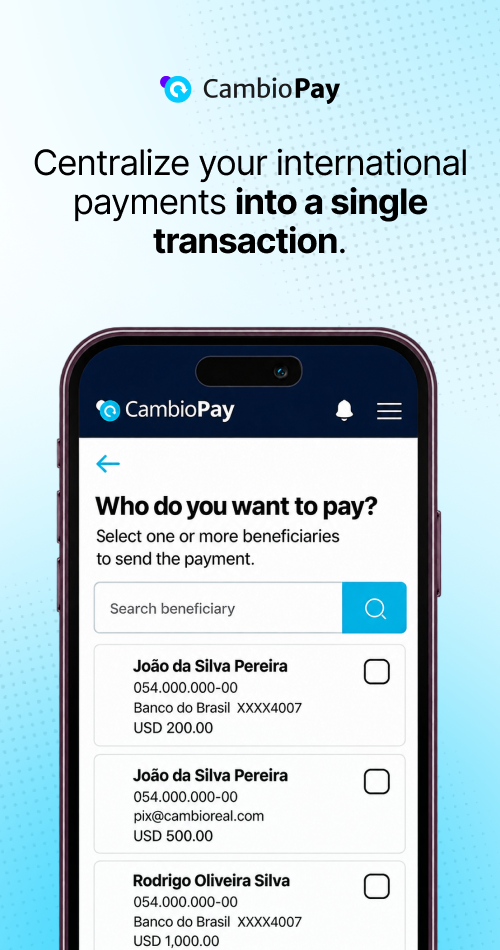
CambioPay was developed for companies that need to make payments from the United States to professionals and suppliers in Latin America. With the platform, companies can organize payments to different beneficiaries while the funds are delivered locally to recipients.
As a result, the company can separate two important stages of the operation: structuring the professional relationship correctly and organizing the international payment.
What does IBM show us about outsourcing in Brazil?
IBM’s trajectory shows that outsourcing in Brazil did not emerge only with the recent growth of remote work. The company has been involved in operations and contracts related to technology outsourcing in the country for decades.
In 2003, IBM was already working with Embratel under an agreement related to technology services. Later, in 2012, the company signed the US$1 billion contract with EBX Group, further expanding its presence in the Brazilian market.
At the same time, the growth of remote work made this type of structure accessible to much smaller companies. Today, U.S. businesses can work with Brazilian professionals without having to reproduce the entire physical structure of a multinational corporation.
However, an efficient operation begins with defining the appropriate hiring model, the responsibilities of each party, and how payments will be processed. After that, management and international payment tools can help keep the operation organized. For companies already working with professionals or suppliers in the country, CambioPay makes it possible to manage international payments from the United States to Brazil through a solution designed for operations across the Americas.
Pay your international team with ease and low fees using CambioPay!
Centralize payments for employees, freelancers, contractors, and suppliers across Latin America in a single operation. With CambioPay, your company:
- Pays in dollars, and your contractors receive it in their local currency;
- Reduces manual processes and gains more control over international workflows;
- Receives low-rate alerts in real time;
- Schedules payments strategically based on the day’s exchange rate.