Accepting Pix from Brazilian customers is not simply a matter of displaying a QR code at checkout. For a U.S. company, the real challenge begins after the customer pays in Brazilian reais: the transaction must be identified correctly, processed through the appropriate local infrastructure, converted into U.S. dollars, reconciled, and settled into a U.S. business bank account without creating unnecessary operational or compliance exposure.
That distinction matters because Pix itself is a domestic Brazilian payment rail. The Central Bank of Brazil describes Pix as an instant payment system that moves funds between participating accounts within seconds and remains available around the clock. By May 2026, more than 170 million individuals had used Pix, with more than seven billion transactions processed during that month alone.
However, U.S. businesses still need a cross-border structure around the local payment. The payment processor must connect the BRL transaction with foreign exchange, customer identification, transaction records, and USD settlement.
Why a Pix payment to a U.S. company is more than a QR code
A Brazilian customer experiences Pix as a simple banking action, but the merchant experiences a larger financial workflow. The buyer pays locally in BRL, while the seller expects to receive an agreed amount in USD. Between those two events, the transaction needs a processor capable of connecting local collection with international settlement.
This is especially important because Brazilian foreign-exchange activity operates under a regulated framework. Brazil’s foreign-exchange legislation establishes rules for transactions involving residents and non-residents, while authorized institutions remain responsible for customer identification, transaction classification, and regulatory procedures. Companies evaluating cross-border payment providers should therefore look beyond checkout design and consider the regulated infrastructure supporting the movement of funds.
For a broader understanding of the payment rail itself, businesses can review how Pix became Brazil’s dominant instant payment method. The practical question for a U.S. CFO, however, is not whether Pix works in Brazil; it is how to integrate Pix without forcing the company to build a Brazilian banking operation around it.
How international Pix payments work step by step
A reliable international Pix workflow separates the customer-facing payment from the foreign-exchange and settlement processes happening behind the scenes. Although interfaces differ between providers, the operational sequence generally follows six stages.
1. The U.S. business creates the payment request
The merchant begins by defining the amount it expects to receive, normally in USD. Depending on the provider, the request may be generated as a hosted payment link, invoice-linked checkout, payment button, or API-created transaction embedded within an existing website or application.
For businesses with lower transaction volume, payment links can reduce implementation work because no custom checkout development is required. Companies processing larger volumes may prefer API integration because transaction creation, status updates, reconciliation, and customer communications can be connected directly to their existing systems.
2. The Brazilian customer enters the local checkout
The customer opens the checkout and provides the information required by the payment provider. A well-designed checkout should minimize unnecessary friction while still collecting the information needed to process the transaction.
3. The system generates a Pix payment
After the customer selects Pix, the platform generates the payment instructions, usually through a QR code and a copy-and-paste code. Following the checkout, the customer then authorizes the payment through a Brazilian banking or payment application, rather than entering international bank details or initiating an overseas wire.
The underlying Pix transfer is normally completed within seconds and operates continuously, including weekends and holidays. The Central Bank of Brazil’s official Pix guidance confirms that the system provides real-time settlement and operates twenty-four hours a day, seven days a week.
4. The payment is received locally in BRL
At this stage, the customer has completed a domestic Brazilian payment, but the U.S. merchant has not yet received an international settlement. The local processor confirms receipt of the BRL funds and links that payment to the correct transaction record.
An integrated processor should provide clear payment status information without requiring the finance team to investigate every successful transfer individually.
5. Foreign exchange converts the transaction into USD
The transaction now moves from a local payment workflow into a cross-border financial workflow. The provider applies the agreed exchange-rate methodology and processes the conversion between BRL and USD through the appropriate regulated structure.
This is where finance teams should examine pricing carefully. A provider may advertise no subscription fee while recovering revenue through an exchange-rate spread, or it may charge merchant fees, settlement fees, onboarding costs, transaction fees, or some combination of these.
Brazil’s foreign-exchange regulatory framework should also remain part of vendor due diligence, because international collection ultimately involves regulated currency conversion rather than Pix alone.
6. The merchant receives settlement in the United States
Finally, the processor transfers the converted funds into the merchant’s U.S. bank account. The original CambioReal workflow uses automatic settlement to the U.S. business account, reducing the need for the merchant to maintain a Brazilian bank account or manually repatriate funds.
Current CambioReal materials also state that CambioCheckout can support payment links, API-based collection, local methods including Pix, and direct settlement to U.S. accounts.
What to evaluate before choosing a Pix payment provider
The most important questions concern how reliably the provider connects customer conversion, compliance, foreign exchange, reconciliation, and settlement. Before signing a contract, finance and operations teams should review the following areas:
- Local payment experience: customers should complete Pix using familiar Brazilian banking flows without unnecessary international payment steps.
- FX transparency: the business should understand when the exchange rate is established, how long a quote remains valid, and whether the merchant or customer absorbs the spread.
- Settlement structure: confirm payout timing, minimum withdrawal thresholds, transfer method, reserve policies, and potential settlement charges.
- Reconciliation: payment status, merchant references, customer information, timestamps, and settlement records should be easy to match against invoices or orders.
- Integration options: compare hosted links, payment buttons, plugins, APIs, webhooks, and technical support according to transaction volume and internal resources.
- Customer support: Brazilian buyers may require Portuguese assistance when a payment fails, expires, or requires clarification, so support availability can affect conversion.
- Compliance responsibilities: determine which party performs customer verification, transaction screening, foreign-exchange processing, documentation, and recordkeeping.
Businesses comparing vendors can also review the main Pix payment systems available for Brazil before deciding how much technical infrastructure they actually need.
Payment links versus API integration
Payment links are usually the fastest option for professional services, education companies, consultancies, law firms, B2B sellers, and other businesses that invoice customers individually. The merchant can define the amount, share the checkout through an existing communication channel, and avoid building a custom payment interface.
API integration becomes more valuable when payment creation needs to happen automatically inside an e-commerce platform, SaaS product, marketplace, or high-volume billing workflow. The Central Bank’s technical standards for Pix interfaces emphasize structured, secure communication between participating institutions, including encrypted connections and standardized authentication requirements.

The official Pix API standards provide useful context on how formalized the underlying ecosystem has become. An international Pix integration should therefore be treated as a production payment system, with monitoring, access controls, failure handling, and reconciliation procedures designed accordingly.
Where CambioCheckout solves the inbound Pix problem
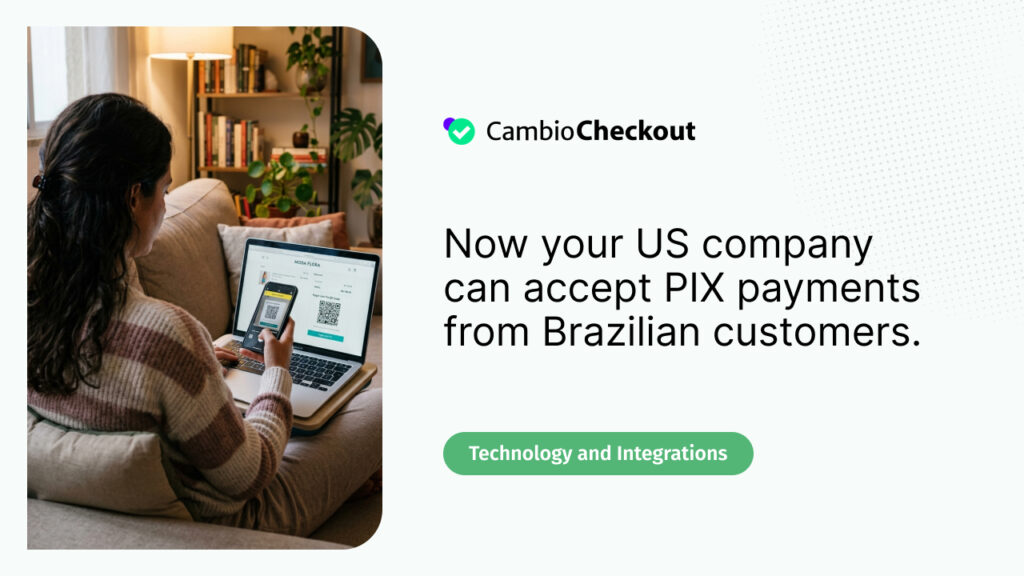
CambioCheckout is designed for the direction of money covered by this guide: Brazilian customers paying a company that wants to receive funds in the United States. Instead of requiring the U.S. business to open a Brazilian bank account, collect BRL independently, convert balances manually, and then arrange an international transfer, the platform connects those stages within one payment workflow.
According to CambioReal’s current materials, companies can create payment links or integrate the checkout into a website, while customers in Brazil can choose local payment methods such as Pix. CambioCheckout then processes the local payment, handles the conversion structure, and settles the corresponding amount into the company’s U.S. bank account.
The platform addresses several operational limitations associated with older approaches:
- no need to maintain a local Brazilian bank account solely for customer collections;
- no subscription fee for the merchant under the current CambioCheckout model;
- payment links for companies that do not need a custom integration;
- API support for businesses that require a more automated checkout;
- automatic settlement without a merchant manually repatriating each payment;
- Portuguese and English support for payment and integration issues.
Companies assessing the economics can also compare why offering Pix may reduce payment friction for Brazilian customers with their current card, wire, or manual invoicing process. The strongest business case usually appears when local customer convenience and finance-team efficiency improve simultaneously.
Where CambioPay fits: outbound payments require a different workflow
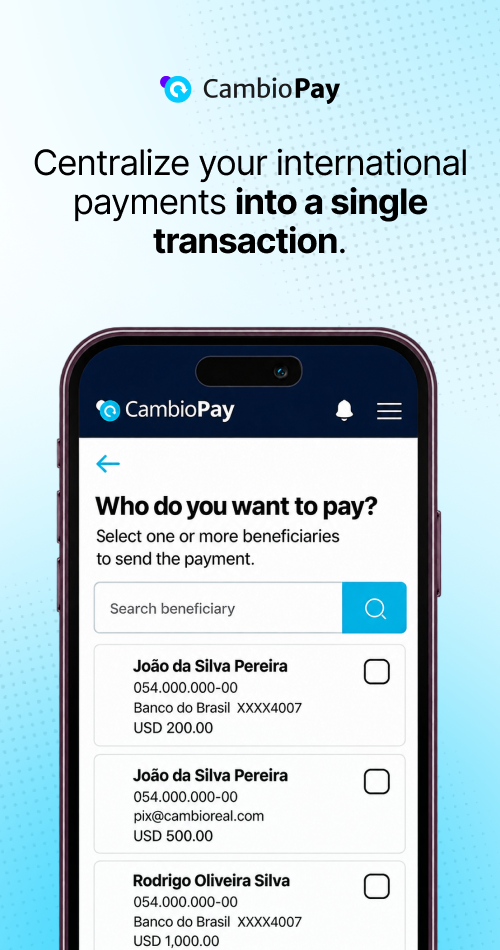
CambioPay addresses the opposite direction of money movement and should not be confused with CambioCheckout. While CambioCheckout helps a U.S. business receive money from Brazilian customers, CambioPay is designed for U.S. companies sending payments to contractors, employees, or service providers in Brazil.
For outbound payments, CambioPay focuses on limitations that become expensive when payroll or contractor volume grows. CambioReal states that the platform supports batch payments, allowing a U.S. company to fund multiple Brazilian beneficiaries through a single USD payment rather than repeating individual international transfers.
The platform also supports management of contracts and invoices, while beneficiaries can generate invoices within the CambioPay workflow and maintain their payment information.
Consequently, the main operational benefits are different from those of inbound Pix collection:
- Zero subscription fees: the platform uses a pay-as-you-go structure rather than adding a recurring software commitment.
- Batch disbursement: one funded payment can cover multiple beneficiaries, reducing repetitive banking work.
- Invoice and contract management: supporting documents can remain connected to the payment workflow instead of being scattered across email and folders.
- Predictable beneficiary amounts: the business can understand the BRL amount associated with the payment before distribution.
- Local delivery: recipients receive BRL into Brazilian accounts without the U.S. company executing separate international wires for every person.
CambioCheckout therefore handles inbound customer collections, while CambioPay supports outbound team and supplier payments.
Build the workflow around reconciliation, not only checkout conversion
A checkout that converts well but leaves accounting teams with incomplete references, unpredictable settlements, or manual matching work simply moves friction from the customer to the back office.
Before launch, document who owns payment creation, expired transactions, refunds, customer inquiries, settlement reconciliation, and accounting classification. Establish the identifiers that will connect each order or invoice with the corresponding Pix transaction and final USD settlement.
Finance teams should also test the full transaction lifecycle before treating the integration as complete. Run realistic payments, confirm status notifications, validate settlement records, compare expected and received USD amounts, and verify how exceptions appear in reporting.
Make Pix part of a scalable Brazil payment strategy
Pix can substantially simplify the customer side of paying a U.S. business, but the merchant still needs reliable infrastructure around foreign exchange, compliance, reporting, and settlement. The strongest implementation therefore combines a familiar Brazilian payment experience with a cross-border workflow designed for the U.S. finance team receiving the money.

For businesses entering Brazil, payment links can provide a fast starting point, while API integration can support higher-volume and more automated operations. CambioCheckout addresses inbound collection without requiring the merchant to build a local banking structure, while CambioPay serves a separate outbound need for companies paying Brazilian teams or service providers.
Boost your sales in Latin America by offering local checkout with CambioCheckout!
Eliminate conversion barriers and provide the best shopping experience for your international customers. With CambioCheckout, your platform:
- Sells in dollars, and your end customers pay in their local currency using the payment methods they already trust;
- Increases conversion rates by reducing cart abandonment caused by international card fees;
- Processes Pix and local payments seamlessly and transparently directly on your page;
- Automates transactional workflows without the need to establish legal entities in each country across the region.